
For CMOs, growth leaders, content leaders, marketing operations teams, and PE operating partners who need AI to improve throughput, protect brand quality, and prove measurable business impact.
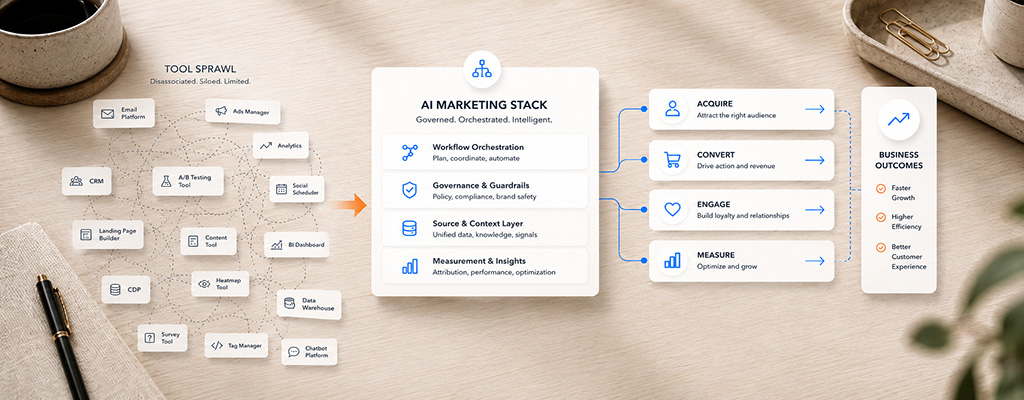
They have a workflow, governance, and review problem. Teams buy AI writing tools, research tools, personalization tools, automation tools, meeting tools, analytics tools, and agentic platforms. Activity increases. Drafts multiply. Dashboards expand.
But the work does not always become easier to approve, easier to measure, or easier to trust.
That is the difference between AI activity and AI capability.
AI activity means people are using tools.
AI capability means the organization has a repeatable way to improve how work gets done.
A real AI marketing tech stack does not start with software selection. It starts with the marketing work that needs to improve:
The goal is not more AI usage.
The goal is governed marketing workflows that reduce labor drag, improve decision quality, and protect brand trust.
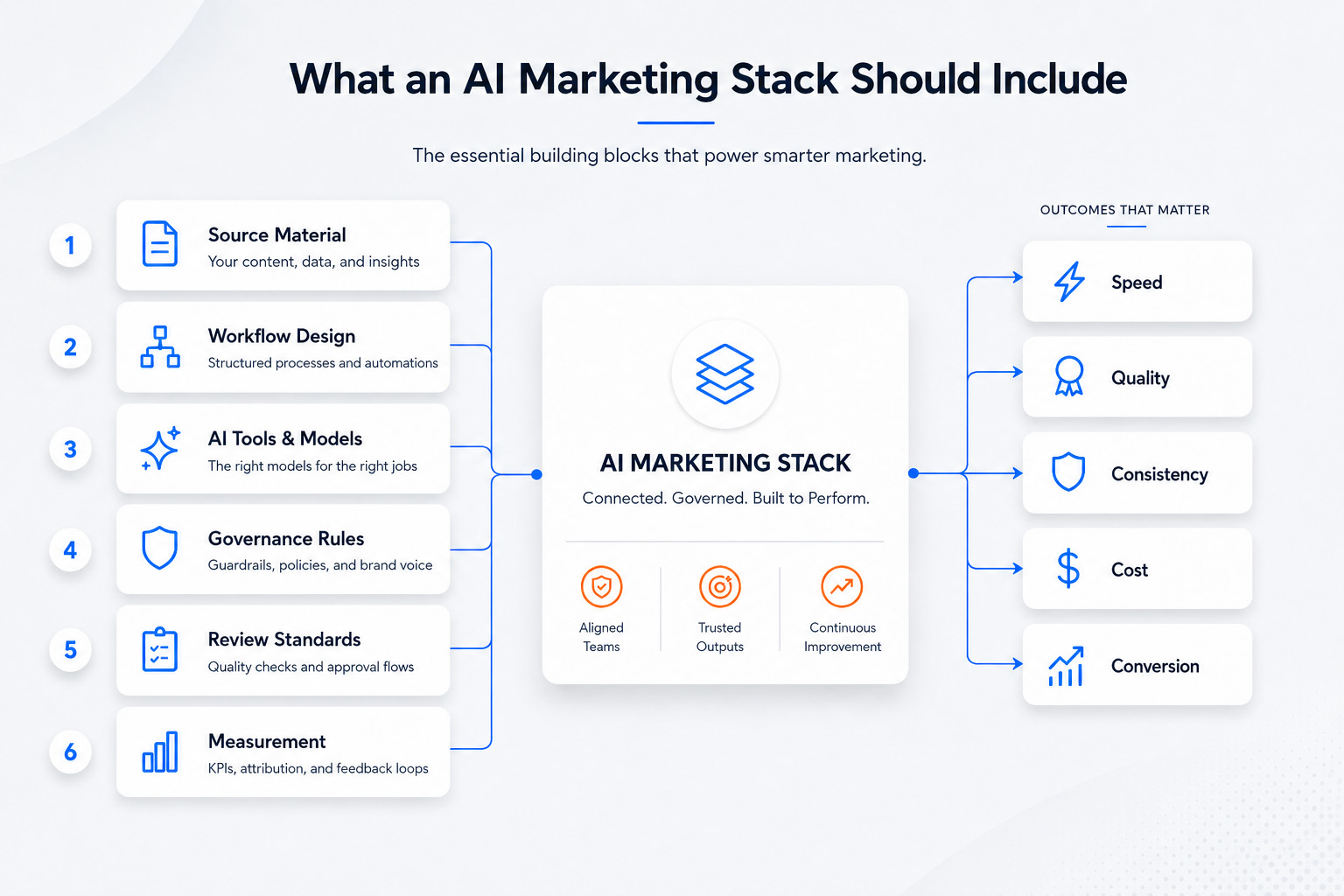
An AI marketing tech stack is the combination of tools, source material, workflows, data connections, governance rules, and review standards a marketing team uses to plan, create, distribute, measure, and improve work with AI.
A tool list tells you what software the team owns.
A stack tells you how the work gets done. That distinction matters.A marketing team can own strong tools and still struggle if:
A strong AI marketing stack connects the parts:
The software matters. But the operating system around the software matters more.
A high-performing AI marketing stack requires five operating requirements.
The first leadership question should not be:
Which AI tools should we buy?
The better question is:
Which marketing workflow is creating enough friction, rework, or missed opportunity to justify redesign?
That shift keeps AI tied to operating value instead of tool experimentation.
Most marketing AI initiatives do not fail because the tools are weak. They fail because the workflow around the tools is unclear.
Common failure patterns include:
The result is familiar: more activity, more review, more inconsistency, and more pressure on senior people to clean up the work.
That is not leverage.
That is Review Debt.
For many marketing teams, the first workflow worth fixing is content. Not because content is easy, but because content exposes the operating problem quickly.
AI can help teams create more drafts. But if the organization does not have clear source material, brand voice rules, prompt structure, review standards, and ownership, the extra output creates a new bottleneck.
That bottleneck is Review Debt.
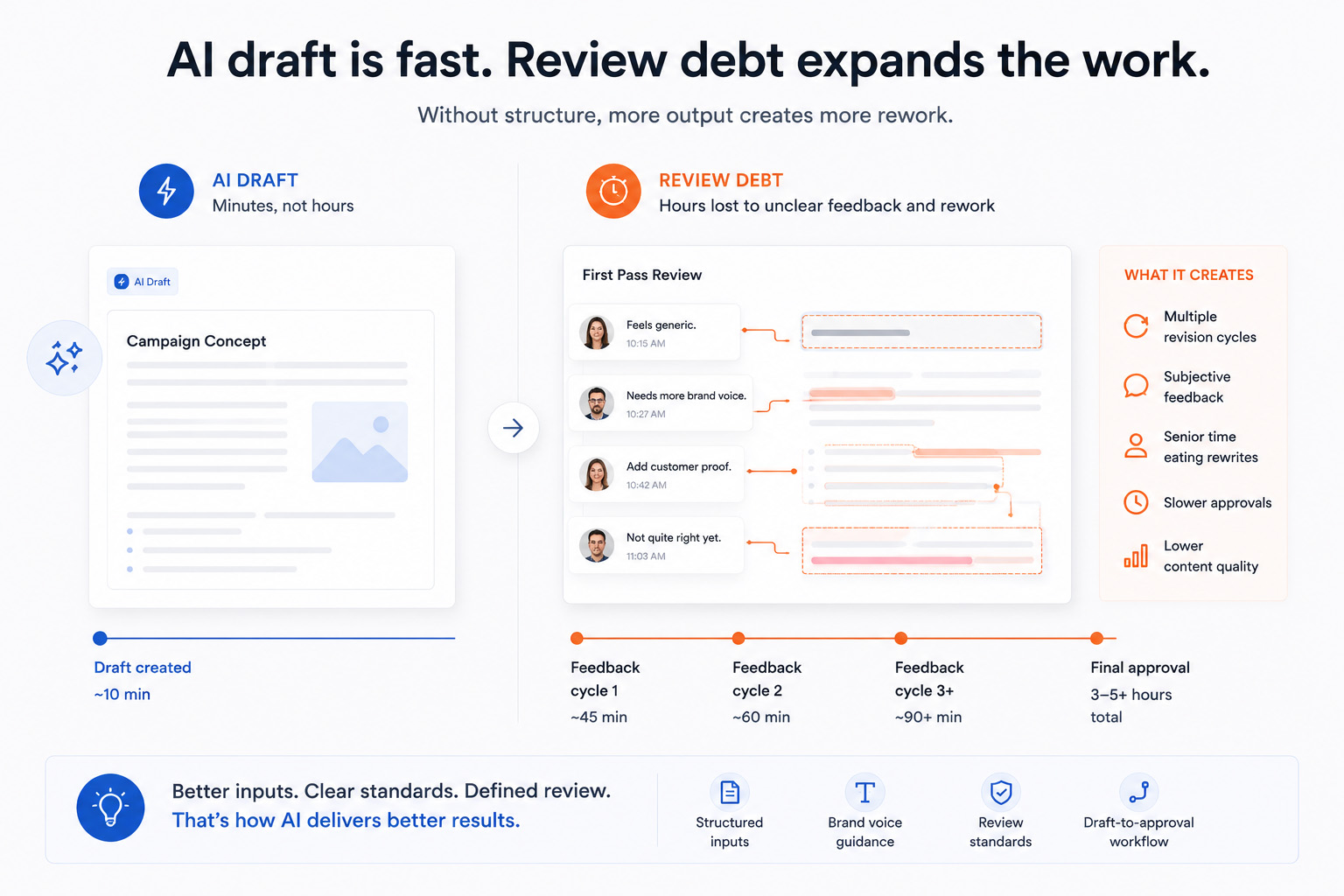
Review Debt happens when AI increases draft volume faster than the team can review, approve, trust, and publish the work.
It shows up as:
The problem is rarely just the model.
The problem is the workflow around the model.
That is why the Pragmatic Content Engine starts with the pieces most teams are missing:
If your team is already using AI for content but still rewriting everything, the next step is not another prompt pack.
The next step is a repeatable content workflow.
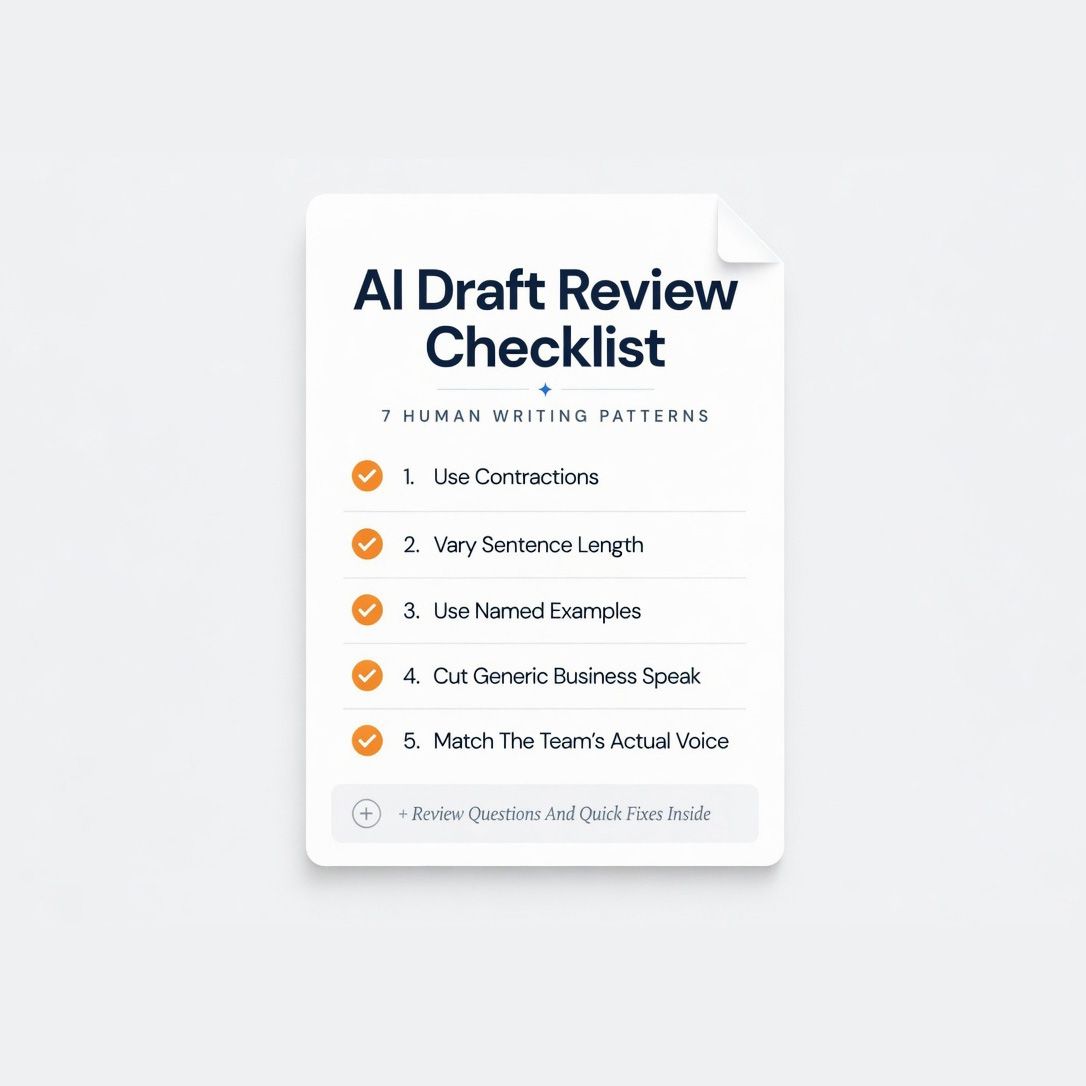
Get the 7-pattern review checklist we use to identify why AI content feels generic, thin, off-brand, or hard to approve.
Get the AI Content Review ChecklistNot a prompt pack. A practical review lens.
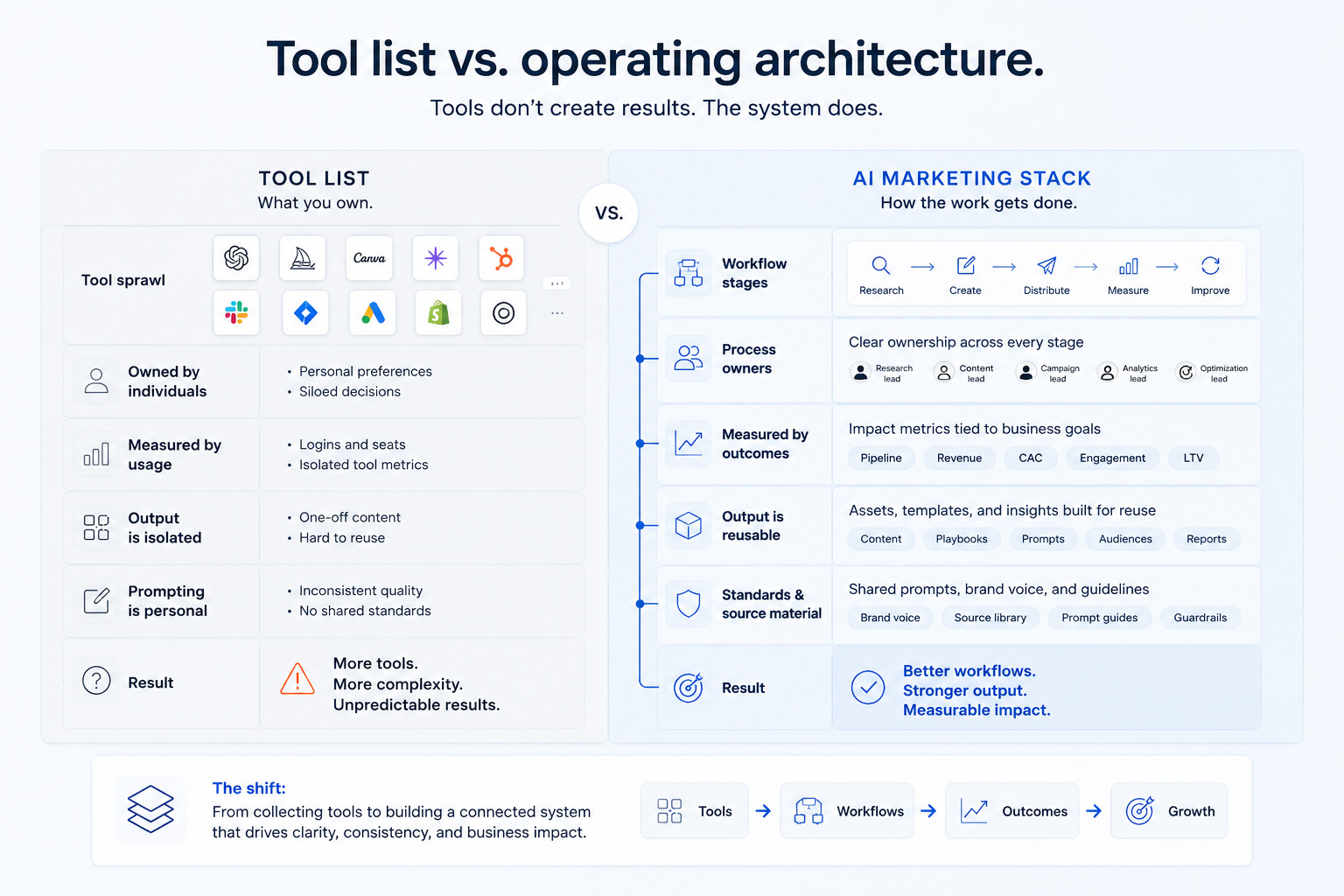
Before evaluating tools, define the difference between a list of AI tools and a real AI marketing stack.
A list of tools is a collection of software subscriptions.
A stack is an operating architecture. It connects tools to workflows, data, owners, review standards, and business outcomes.
A genuine AI marketing stack has three non-negotiable characteristics.
Every tool must serve a defined stage of work.That might be acquisition, conversion, content production, customer engagement, reporting, or operations.If a tool does not map to a real workflow, owner, and success metric, it probably does not belong in the stack.
AI works better when the right information is available at the right point in the process.
For marketing teams, this includes:
Disconnected data leads to disconnected decisions.
Teams need to know:
Governance is not there to slow down marketing.
It is what lets marketing move faster without creating avoidable risk.
Marketing teams can use AI across five practical areas.
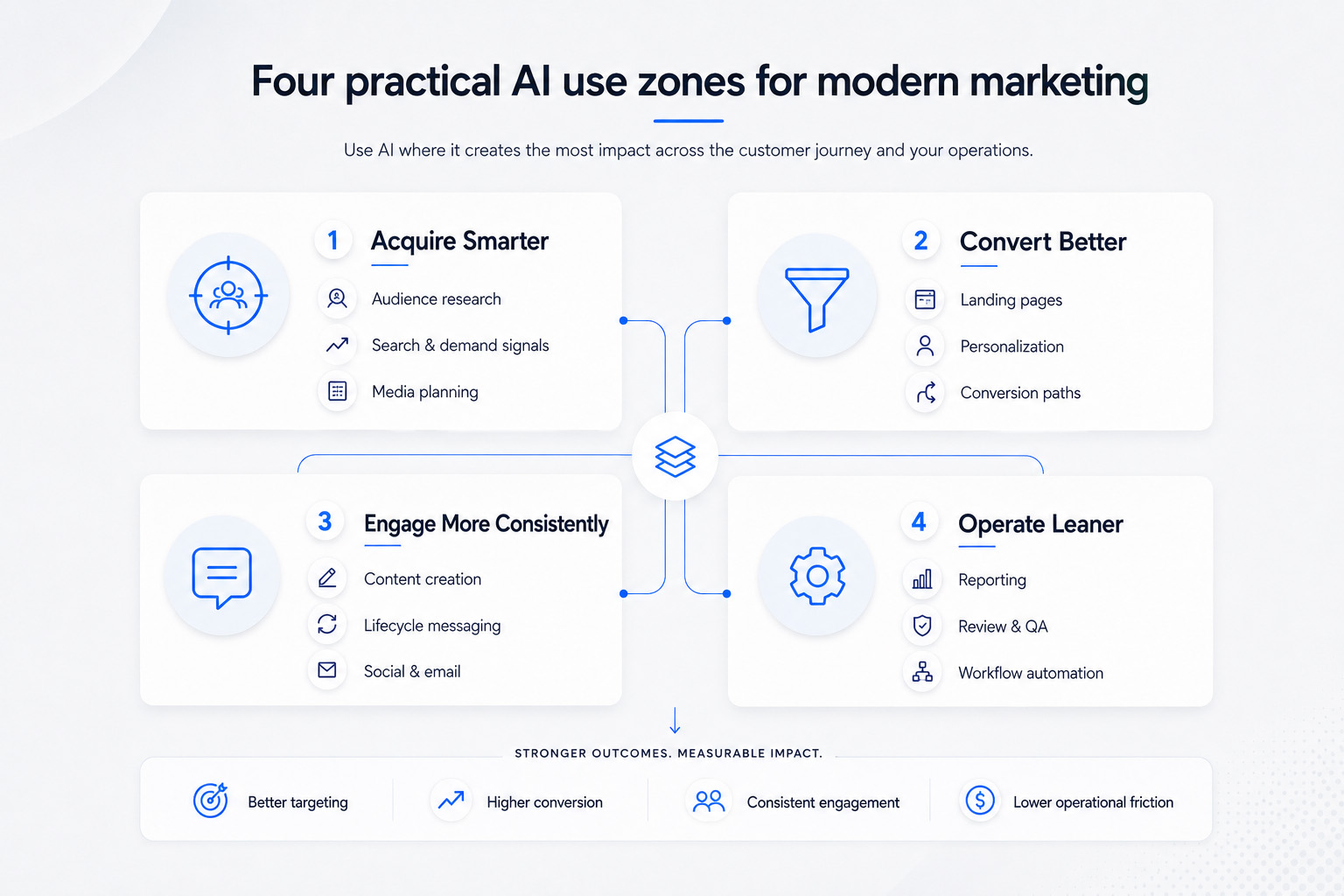
AI can summarize customer interviews, identify repeated objections, analyze call transcripts, cluster survey responses, and surface language patterns. The risk is treating summaries as truth without checking the source.
The better approach is to use AI to make research more usable, not to replace customer understanding.
AI can help with briefs, outlines, repurposing, first drafts, campaign variations, and editorial planning.The risk is generating more content than the team can review or differentiate.
The better approach is to anchor AI in approved source material, brand voice rules, and review standards.
AI can help build campaign variants, personalize messaging, generate audience-specific angles, and adapt assets across channels. The risk is creating disconnected messages that weaken positioning.
The better approach is to use AI inside a shared campaign architecture.
AI can help tailor page content, email paths, CTAs, proof points, and sales enablement based on user needs or account context. The risk is over-personalization that feels invasive, inaccurate, or difficult to govern.
The better approach is to personalize based on meaningful intent and approved messaging rules.
AI can help summarize performance, explain trends, identify anomalies, and suggest next actions. The risk is using AI-generated analysis without understanding the data quality underneath it.
The better approach is to make AI a decision-support layer, not an unquestioned authority.
The mistake is treating every use case as a separate tool purchase. The better path is to choose one workflow, define the owner, clean up the inputs, set review standards, and measure whether the work improves.
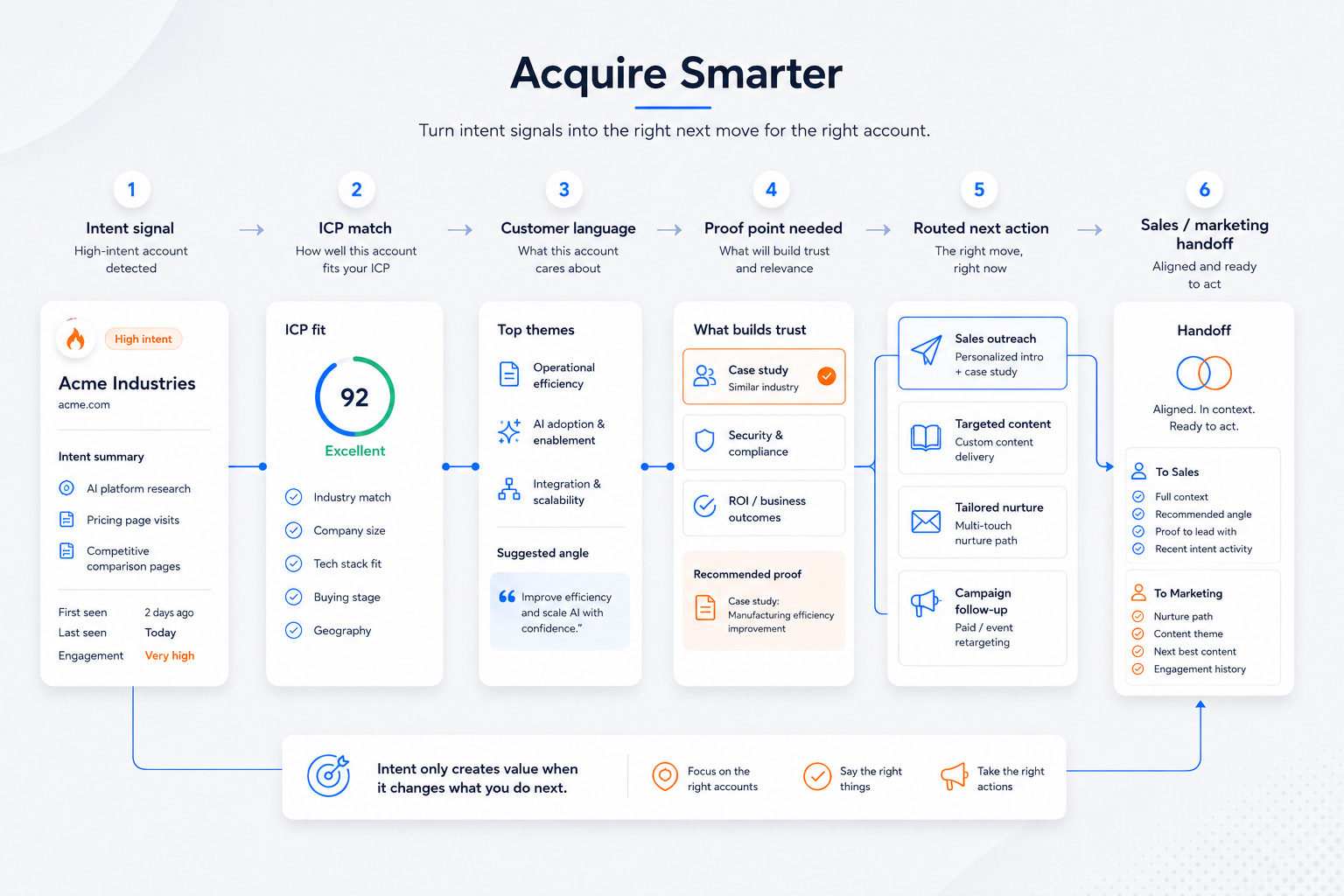
AI can improve acquisition when it helps teams identify the right accounts, understand the right signals, and deliver the right message at the right moment.
But acquisition is not simply a volume problem.
More leads do not help if they are poorly fit, poorly routed, or poorly understood.
A useful AI acquisition stack should help answer:
Intent platforms such as 6sense, Bombora, or similar tools can help teams identify accounts that appear to be researching relevant problems.
Used well, intent data helps sales and marketing focus effort where there is a stronger signal.
Used poorly, it creates another dashboard no one trusts.
The practical question is:
What will we do differently when an account shows intent?
If the answer is unclear, the data will not improve the workflow.For mid-market and PE-backed organizations, intent data is most useful when it is connected to:
The value is not the signal alone. The value is the action the signal enables.
AI can support outbound and account-based marketing by helping teams research accounts, identify relevant triggers, draft outreach, and personalize follow-up.
But this is where teams need discipline.Automated outreach that sounds generic, intrusive, or over-personalized can damage trust quickly.
AI-supported outreach should be governed by:
The goal is not to send more messages. The goal is to send more relevant messages with less manual research and less inconsistency.
Search behavior is changing. Buyers still use Google, but they also ask ChatGPT, Perplexity, Gemini, Claude, Copilot, and other AI systems to summarize options, explain categories, and recommend vendors.
That means marketing teams need content that is easy for both people and AI systems to understand.
Strong AI-search-ready content should include:
The goal is not only to rank. The goal is to become a trusted source that people and AI systems can cite, summarize, and recommend.
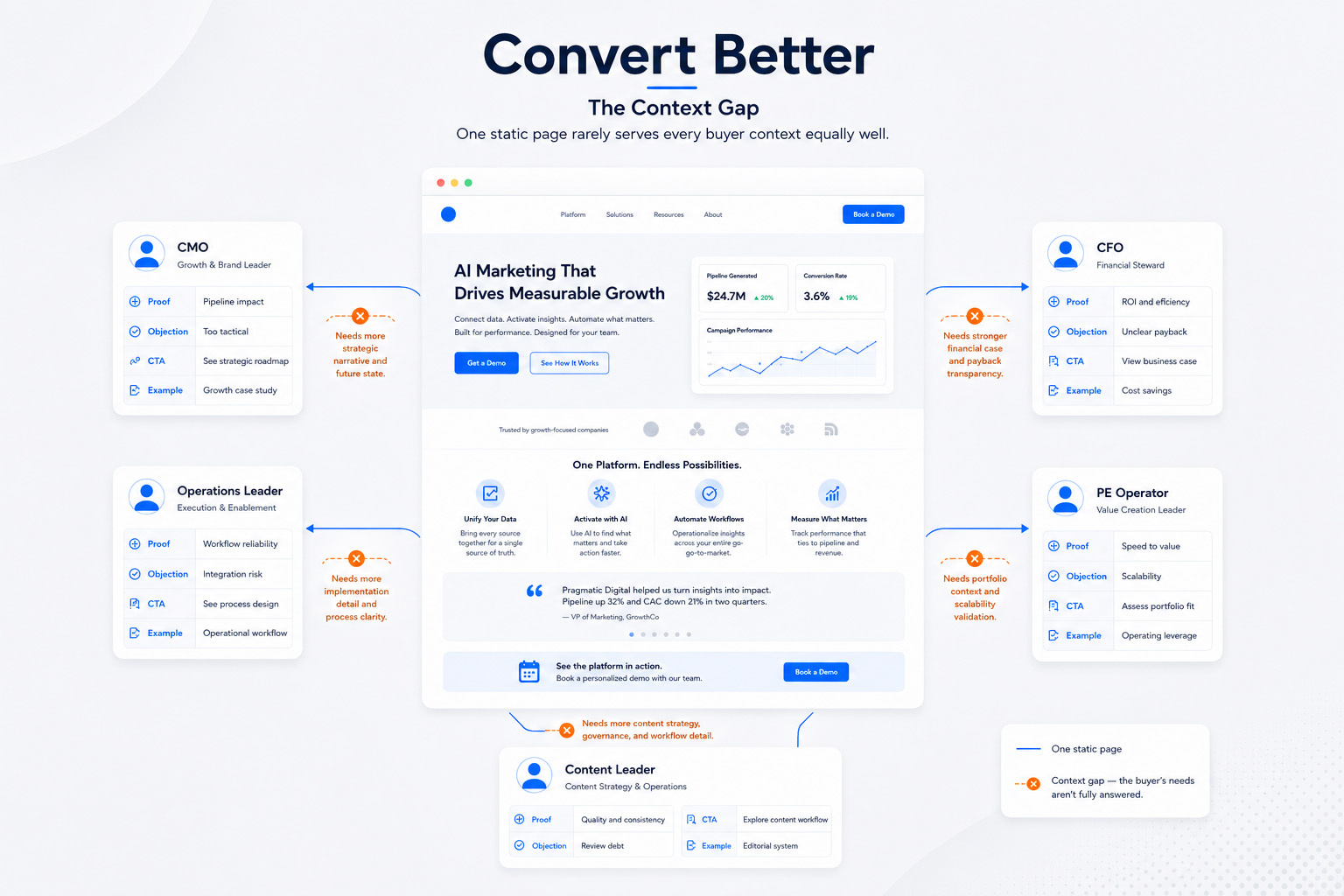
Traffic that does not convert is not an audience. It is an expense.
AI can improve conversion when it helps teams reduce friction, clarify the next step, and match the message to the buyer’s context.
But conversion does not improve just because a page becomes more dynamic. It improves when the page answers the visitor’s real question faster.
Many websites treat every visitor the same.A CFO, CMO, operations leader, founder, and portfolio operator may all land on the same page, but they are looking for different proof.
The gap between what a visitor needs to see and what the page actually shows is the Context Gap.
AI can help narrow that gap by adjusting:
But the system can only do that safely if the underlying messaging and rules are clear.
Traditional analytics tell you what happened.AI-assisted analytics can help explain where users stall.
For example, a tool may identify that visitors from a specific segment repeatedly pause on methodology, pricing, implementation, or risk-related sections.That insight is useful only if someone owns the fix.
The workflow should be:
AI can surface the pattern. The team still needs to make the strategic decision.
AI can also help teams route visitors to more relevant proof.
For example:
The point is not personalization for its own sake. The point is to reduce the buyer’s uncertainty faster.
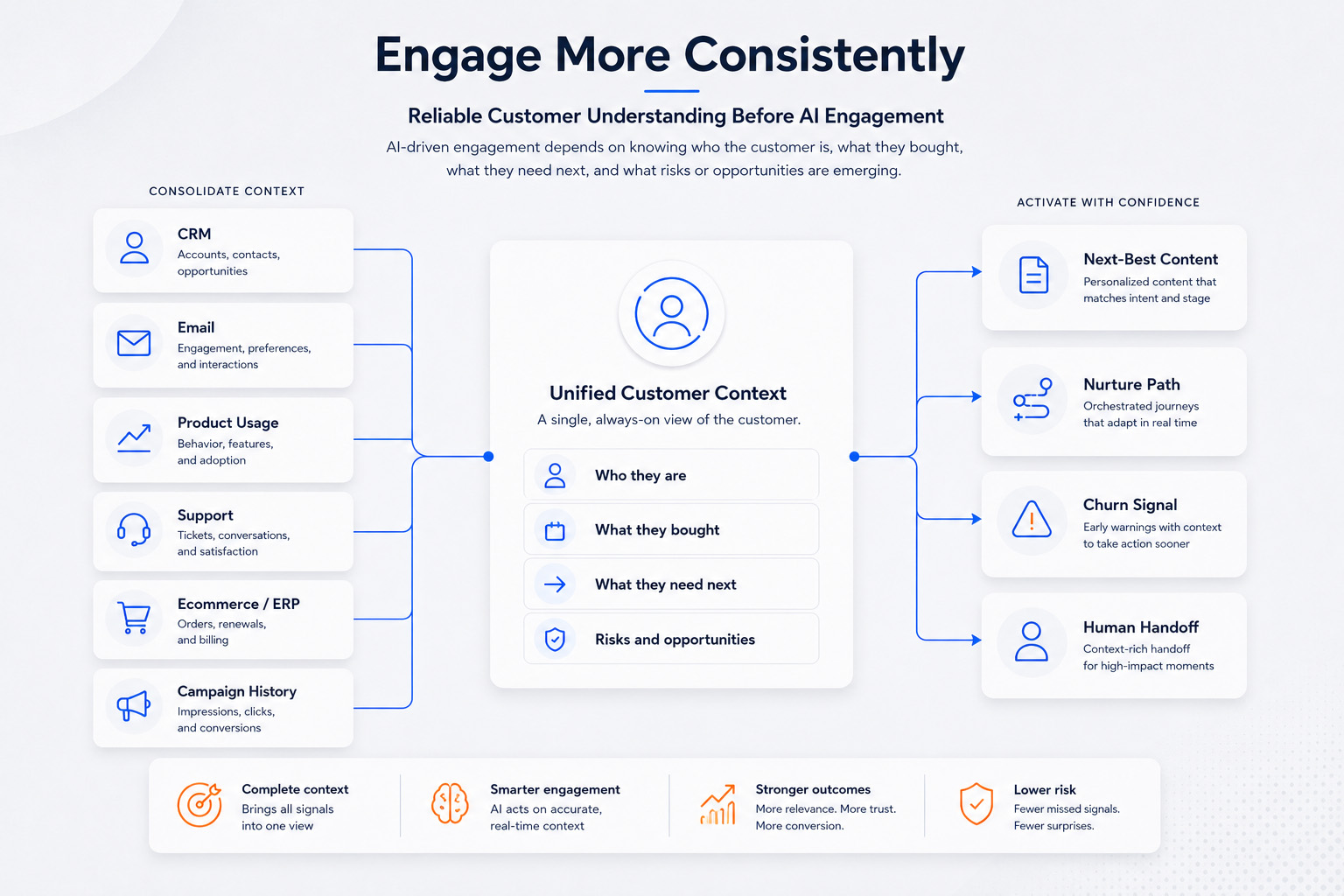
Acquisition gets attention. Engagement and retention create durable value.
AI can help marketing and customer teams maintain more consistent communication across the customer lifecycle, especially when teams are managing complex products, multiple segments, partner channels, or long buying cycles.
But engagement AI needs clean data and clear rules. If the customer record is fragmented, AI will make fragmented recommendations.
A Customer Data Platform or similar customer data layer can help teams unify customer information across CRM, email, product usage, support, ecommerce, ERP, and other systems.
The strategic value is not the platform itself.
The value is a more complete understanding of the customer.
That matters because AI-driven engagement depends on knowing:
AI can only personalize intelligently if the underlying customer data is reliable.
AI-assisted nurture can help teams respond to common questions, route inquiries, follow up over time, and identify when someone is ready for human engagement.But the handoff rules matter.
A useful nurture workflow defines:
The goal is not endless automated communication. The goal is timely, useful, appropriate communication that respects the buyer and protects the brand.
AI can help account teams identify risk patterns before renewal or expansion moments.
This might include:
The system can suggest next-best actions. But the best next action should still be reviewed through the lens of customer context, account strategy, and business judgment.
AI should support account teams. It should not replace relationship ownership.
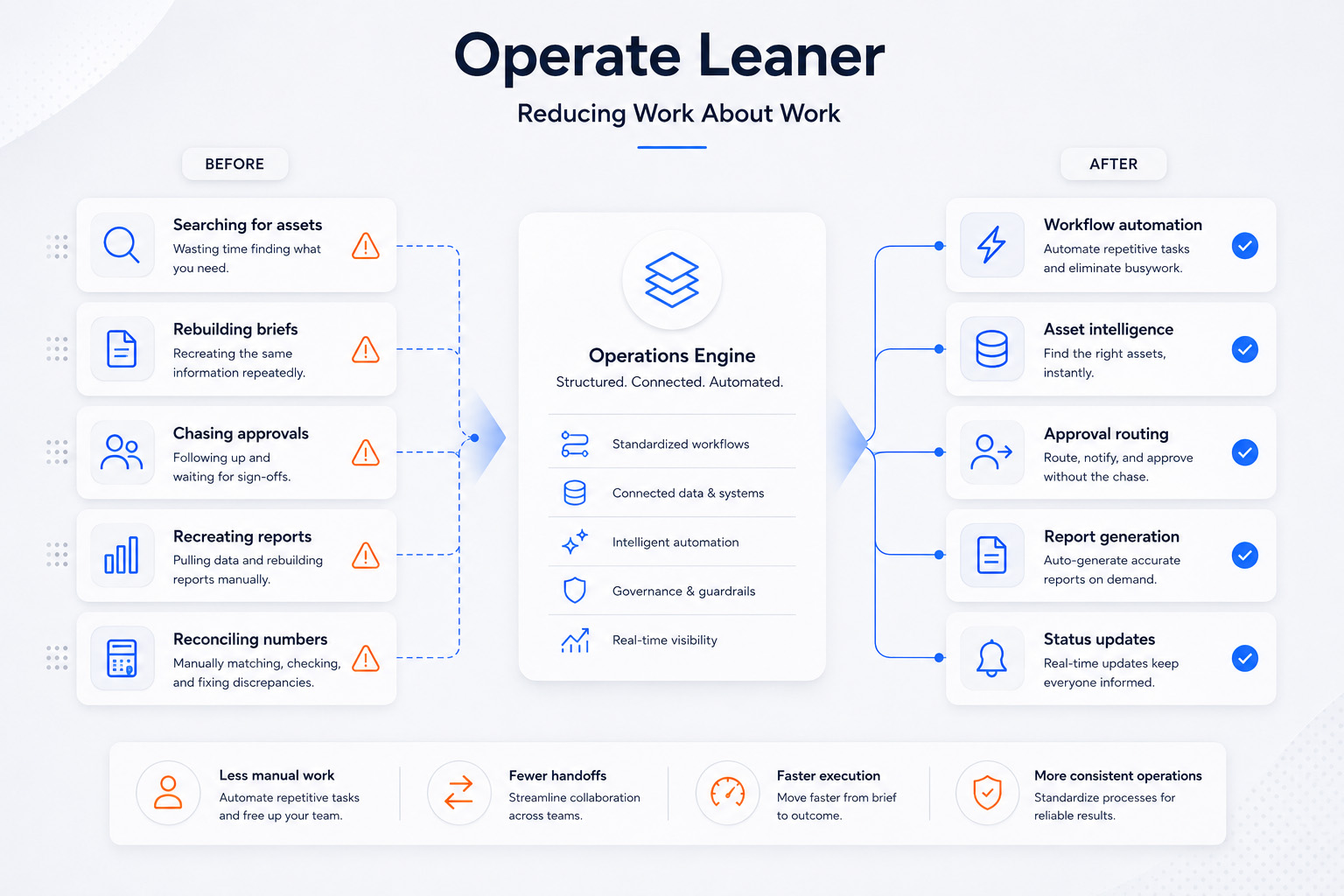
Marketing teams lose time to “work about work.”
That includes:
AI can reduce this drag when it is applied to well-defined workflows. It can also make the mess worse if every team adds tools without shared rules.
Marketing leaders need to understand which investments are producing real value.
AI-assisted attribution, marketing mix modeling, and performance analytics can help teams identify patterns across channels, campaigns, and segments. But leaders should be careful not to mistake model output for certainty.
The best use of AI here is decision support:
A strong stack helps leaders make better decisions faster. It does not pretend the data is perfect.
Some of the most valuable AI use cases are not glamorous. They are the connective-tissue tasks that keep work moving:
Tools like Zapier, n8n, Make, and native platform automations can be useful here. But automation should begin with process clarity. If the workflow is unclear, automation creates faster confusion.
Many marketing teams already have the assets they need. They just cannot find, trust, or reuse them.
AI-powered asset management can help by:
This matters because content quality depends on source material. If the team cannot find the right inputs, AI output will be generic.
Your team should not be loyal to a model. It should be loyal to the workflow.
Models, tools, and platforms will keep changing. A strong AI marketing stack should allow the team to swap tools without rebuilding the entire process.
Choose models and tools based on workflow requirements such as:
The specific tools matter less than the operating architecture. A strong stack should allow tools and models to change while the workflow remains stable.
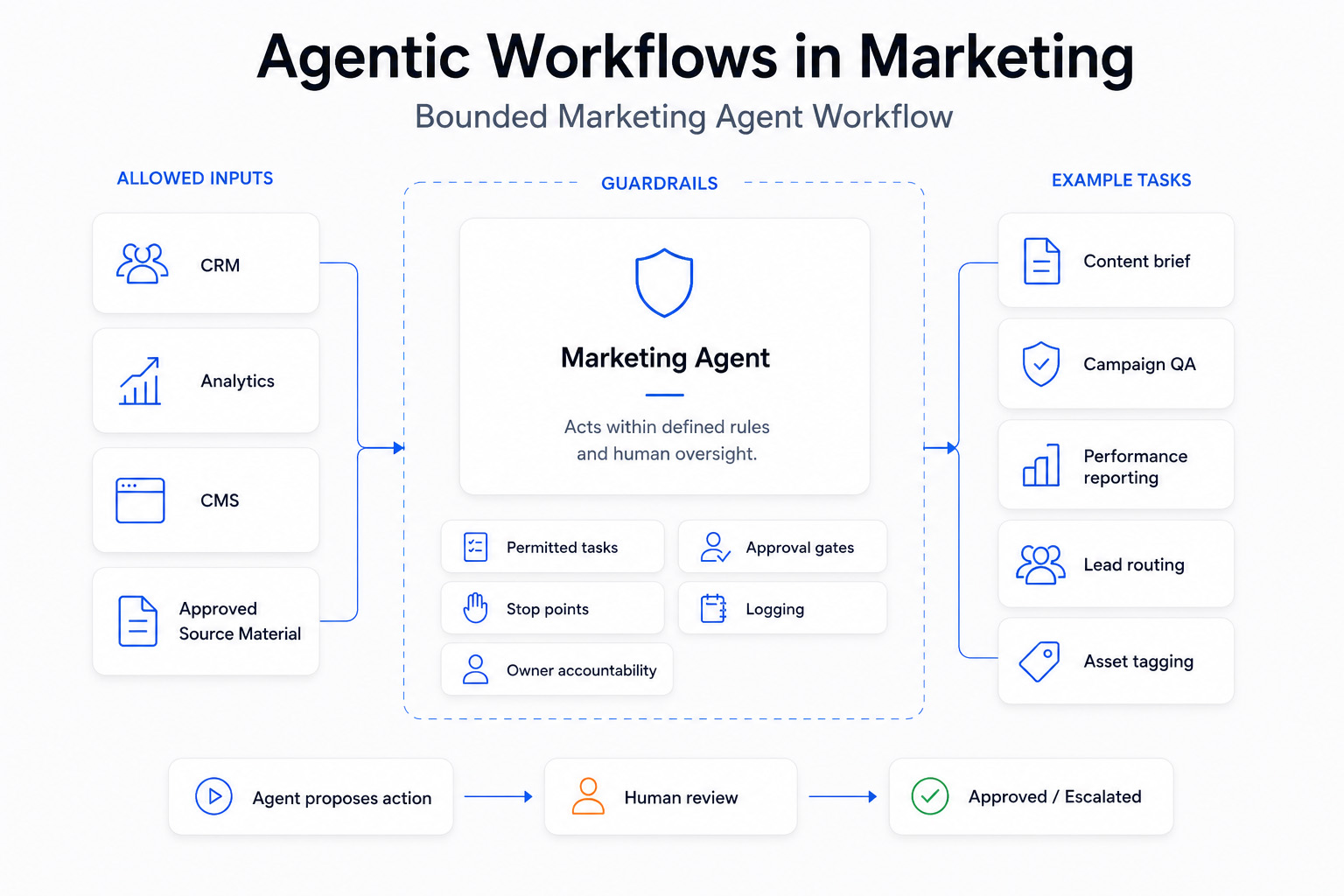
Generative AI helps create, summarize, and analyze.Agentic workflows help move work forward.
An agentic workflow is not just a chatbot. It is a bounded process where AI can take defined steps across systems under clear rules and human oversight.
In marketing, agentic workflows might support:
The key word is bounded.
The workflow should define:
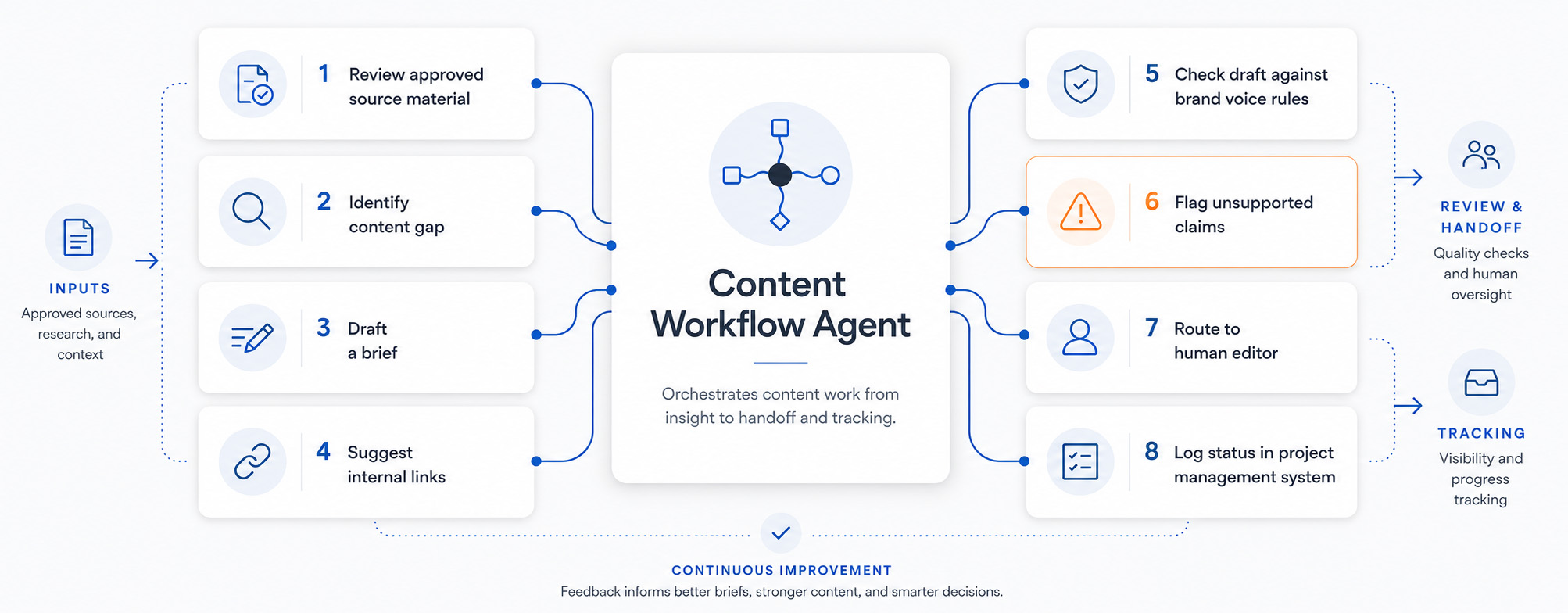
A content workflow agent might:
That is useful because it reduces manual coordination and improves consistency. It is not useful if it creates more content that senior people still have to rewrite from scratch.
A competitive intelligence agent might monitor competitor pages, pricing changes, job postings, product updates, or news mentions.
Each week, it could produce a short summary of:
The agent should not make strategic decisions on its own. It should reduce the time it takes for humans to see and evaluate relevant changes.
Agents need more oversight than simple content generation tools because they can interact with systems and workflows. Treat an agent less like a plug-in and more like a junior employee with restricted permissions.
Define:
Agentic speed without governance creates risk. Agentic workflows with clear boundaries can create operating leverage.

The Pragmatic Content Engine helps marketing and content teams turn scattered AI use into a governed workflow for source material, brand voice, prompt structure, review standards, and publishing readiness.
Explore the Pragmatic Content EngineBuild the workflow before you scale the output.
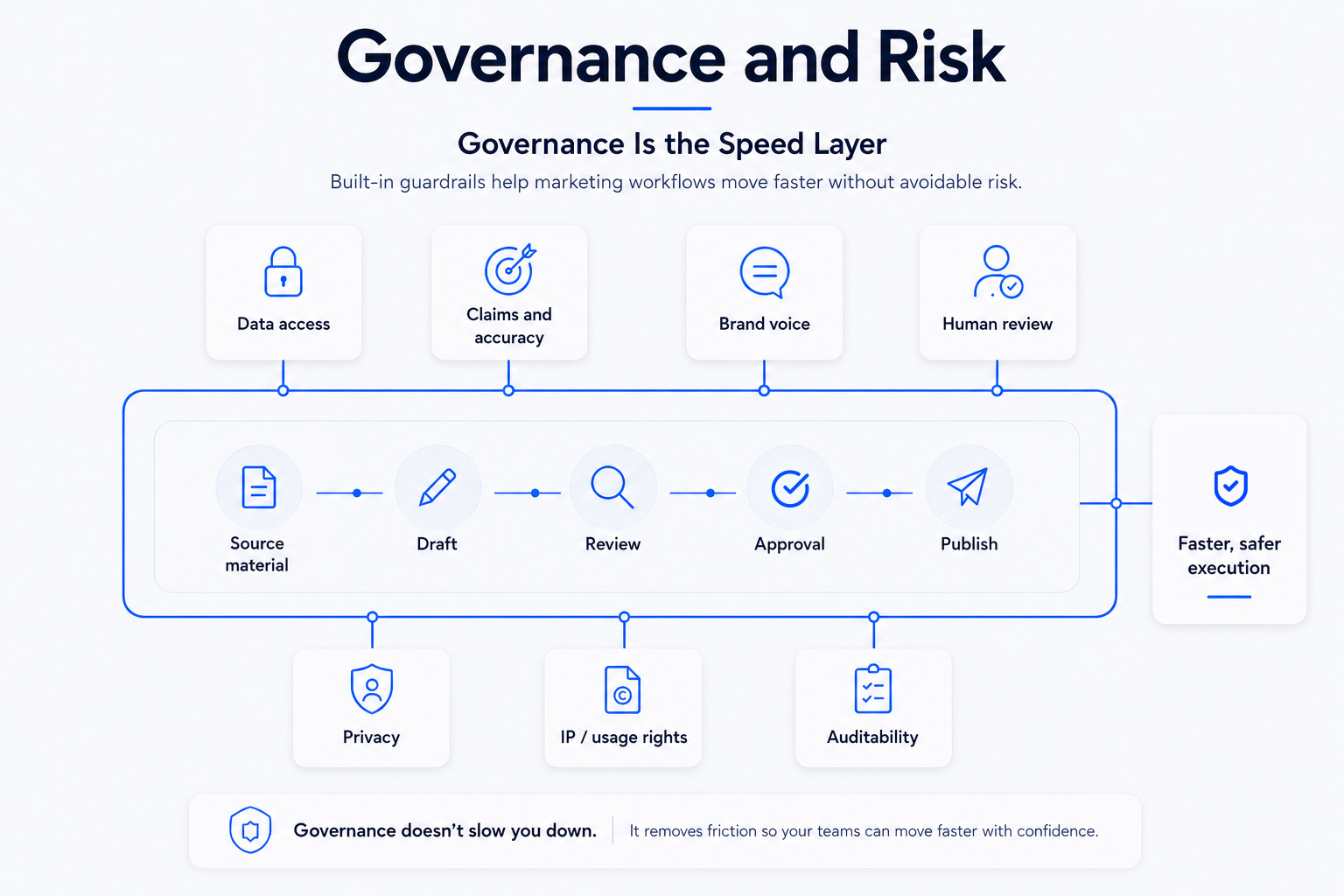
AI governance is not just an IT, legal, or compliance issue. It is a marketing operating issue.
Marketing teams work with customer data, claims, positioning, audience segments, paid media, creative assets, sales enablement, and public-facing content. Ungoverned AI can create risk in all of those areas.
A practical governance model should answer:
Shadow AI happens when employees use unsanctioned AI tools without clear policy, security, or oversight.
The risk is practical:
The solution is not to ban AI. The solution is to give teams approved tools, clear rules, and workflows that are easier to use than workarounds.
Human review is not a sign that AI failed.It is how responsible teams preserve judgment, quality, and accountability.
Customer-facing content, claims, regulated messaging, sales materials, and high-impact recommendations should have defined review gates.The review process should be specific.
Not:
Make this better.
But:
Clear review standards reduce rework. They also make AI-assisted work easier to scale.
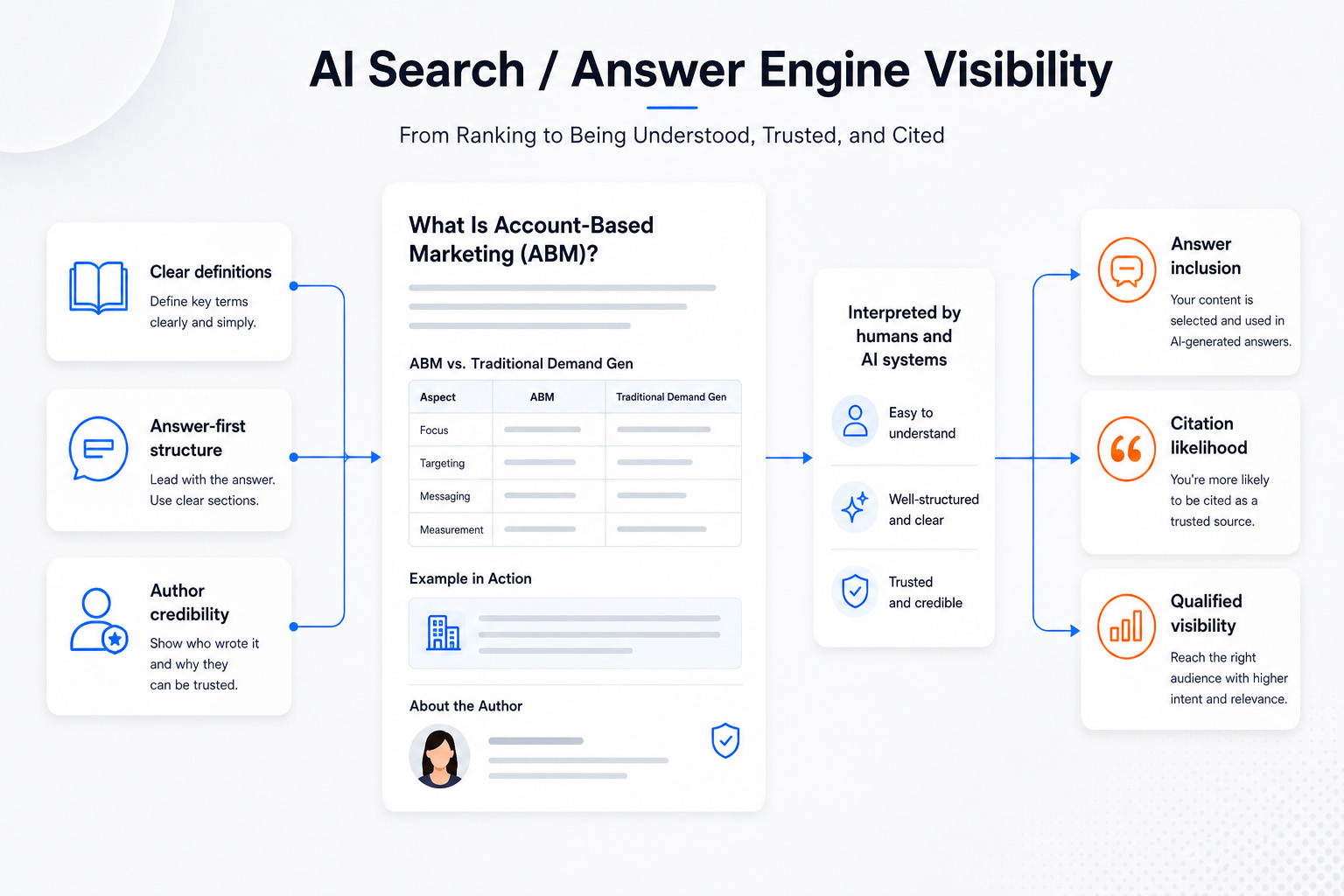
Search is changing. Buyers still use Google, but they also ask AI systems to compare options, explain categories, summarize vendors, and recommend solutions.That means your content needs to work for both traditional search and AI-generated answers.
The old SEO goal was to rank.
The new goal is to be understood, trusted, and cited.
AI search systems favor content that is clear, structured, current, and easy to extract.
A strong page should include:
This is not just an SEO tactic. It is a clarity discipline.
If a human has to work too hard to understand what your page says, an AI system will also struggle to summarize it accurately.
For marketing teams, this changes the content workflow. Content should not be created only to publish. It should be structured so buyers, sales teams, internal teams, and AI systems can all understand and use it.
That requires better source material, clearer point of view, and stronger review standards.
Scaling AI is not mainly a tool-selection problem.
Most companies already have access to capable AI platforms. What they lack is a disciplined way to decide where AI belongs, how it should be governed, and which workflows are worth improving first.
The organizations that make progress will not be the ones testing the most tools. They will be the ones that connect AI to specific business processes, define decision rules early, and scale only after the workflow has proven value.
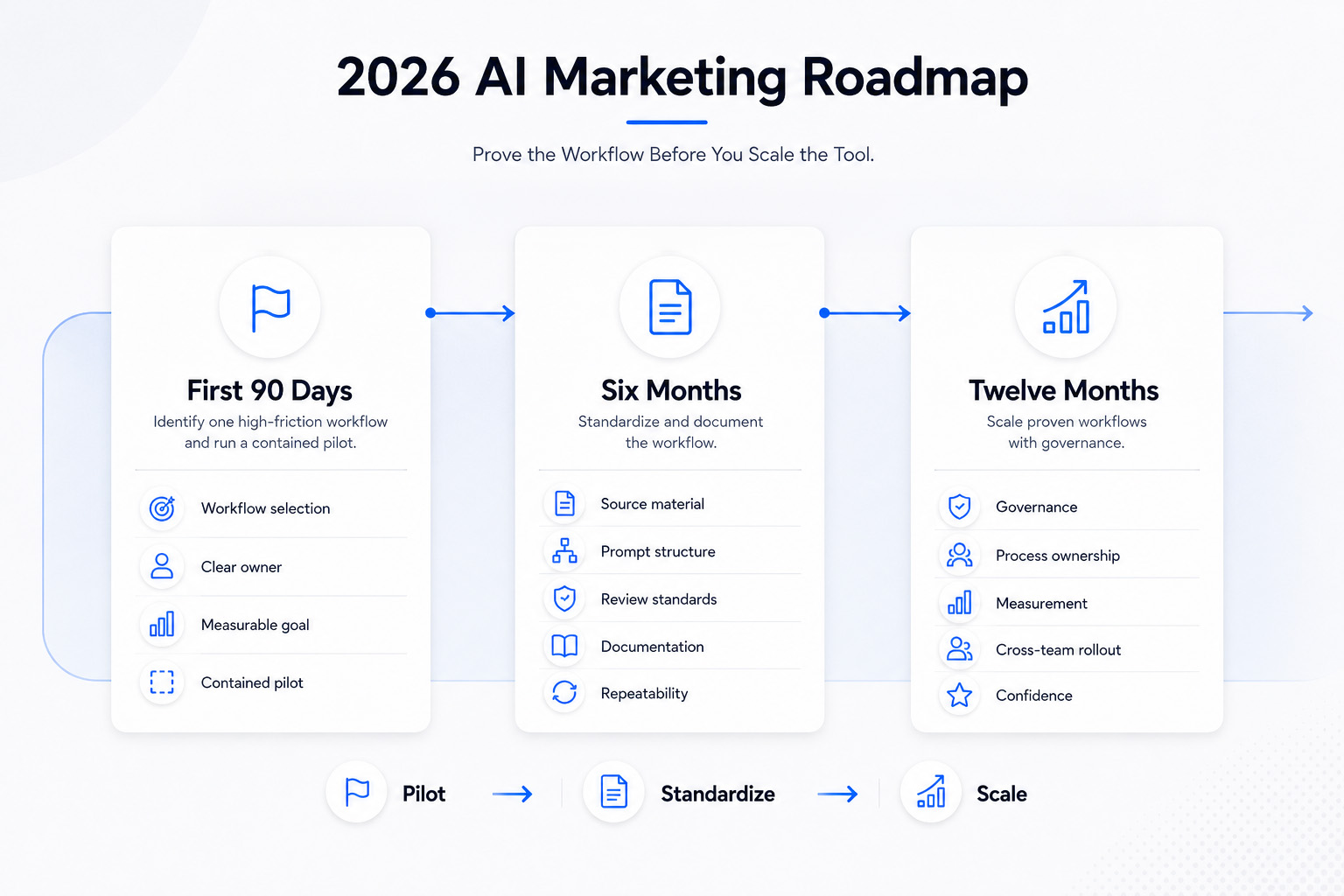
The roadmap is simple: Start with one workflow. Prove the operating case. Then expand with governance.
Goal: Identify the right workflow and prove whether AI can improve it.
AI adoption should not begin with a vendor demo. It should begin with a practical review of where work is slow, repetitive, inconsistent, expensive, or overly dependent on a small number of people.
Before investing in new tools, leadership should identify the workflow where AI has a clear chance to improve throughput, quality, cycle time, or decision support.
The question is not:
Where can we use AI?
The better question is:
Which workflow is creating enough friction to justify redesign?
In the first 90 days, the organization should:
The pilot should be narrow enough to manage, but meaningful enough to prove whether AI can improve the way the work gets done.
If the workflow does not show a credible path to business value, stop it early.
That is not failure.That is disciplined execution.
Goal: Standardize the workflow and make it repeatable.
Once a pilot shows value, the work shifts from experimentation to standardization. This is where many AI initiatives stall.
The first version may work for one person or one team, but it often depends on informal knowledge, inconsistent prompting, unclear review standards, or undocumented source material.
At this stage, the organization needs to turn a useful pilot into a repeatable workflow.
What needs to happen
The six-month focus should be:
The six-month focus should be:
This is where AI starts to become operationally useful.Not because the model is better, but because the process around the model is clearer.
This often shows up in content production, campaign planning, customer research, sales enablement, and reporting workflows.
The strongest use cases are not the flashiest. They are the ones where better inputs, clearer rules, and repeatable review can reduce rework and improve output quality.
Goal: Scale what works without losing control.By the end of the first year, the goal is not to have AI everywhere.
The goal is to have a small number of proven workflows that can be governed, measured, and expanded responsibly.
This is where organizations move from isolated AI use to operating discipline.AI workflows should have:
The 12-month focus should be:
This is the difference between AI activity and AI capability. Activity is scattered tool use. Capability is a repeatable way to improve how work gets done.
For many marketing teams, the first useful place to start is content.
Not because content is easy. Because content exposes the operating problem quickly:
That is why we built the Pragmatic Content Engine. The Pragmatic Content Engine gives teams one repeatable AI-assisted content workflow with:
The goal is not to create more AI content. The goal is to make AI-assisted content easier to approve, trust, and scale.
The 2026 AI marketing stack is not a shopping list.It is an operating decision.
Companies that chase tools will keep adding subscriptions, dashboards, and experiments.
Companies that build capability will identify the workflows that matter, prepare the right source material, set clear rules, and measure whether the work actually improves.The better path is narrower and more disciplined:
Pick one outcome. Prove the workflow. Then scale what works.
If your marketing team is stuck evaluating vendors, rewriting AI drafts, struggling with tool sprawl, or trying to prove hard ROI, the issue may not be the tools.
It may be the operating system around them.

Start with the practical review tool.The AI Content Review Checklist helps you identify the patterns that make AI-assisted content feel generic, thin, off-brand, or hard to approve.
Get the AI Content Review ChecklistNot a prompt pack. A practical review lens.
Turn scattered AI use into a repeatable content workflow for source material, brand voice, review standards, and publishing readiness.
Explore the Pragmatic Content EngineBuild the workflow before you scale the output.
Identify the AI workflows worth funding, clarify the blockers, and move toward governed, measurable adoption.
Apply for an AI Readiness Debrief30 minutes. Fit, blockers, and a clear next step.


A growth-focused Fractional CMO was drowning in reactive prep work—scrambling before client calls, redoing intake notes, and wasting time on repetitive decks.She applied just two workflows from the toolkit and immediately:

Weekly insights on AI adoption, workflow, and what's actually working in mid-market organizations.

