
Menu

A strategic guide for mid-market and PE-backed leaders turning conversational interfaces into governed, measurable workflows.
Voice AI allows people to interact with digital systems through spoken language. Conversational AI is the intelligence layer that interprets intent, manages dialogue, retrieves approved information, and can route or execute workflow steps across business systems. In mid-market and PE-backed companies, the value is not the interface itself. The value comes when voice and conversational AI are connected to governed workflows, clean enterprise knowledge, and measurable operating outcomes.
Voice and conversational AI are moving from novelty interfaces to operational infrastructure because organizations are facing a growing execution gap.
Companies are creating more content, managing more systems, supporting more channels, and responding to more customer and employee questions than ever before. Yet many still rely on static websites, overloaded support teams, disconnected portals, manual lookups, and delayed follow-up processes.
This creates friction in the moments that matter:
A firm’s value is increasingly influenced by what we describe as Journey Velocity: the speed, accuracy, and consistency with which it can move customers, employees, and partners through high-friction points. Organizations that reduce friction through governed systems tend to outperform those that remain dependent on fragmented processes and slow-response manual work.
Voice and conversational AI matter because they can reduce friction at the point of work. But they only create business value when they are connected to approved knowledge, clear workflow rules, and measurable operating outcomes.
This guide breaks down the strategic business case for a governed conversational AI strategy and explains how leadership teams should evaluate these systems before they fund another tool, pilot, or platform.
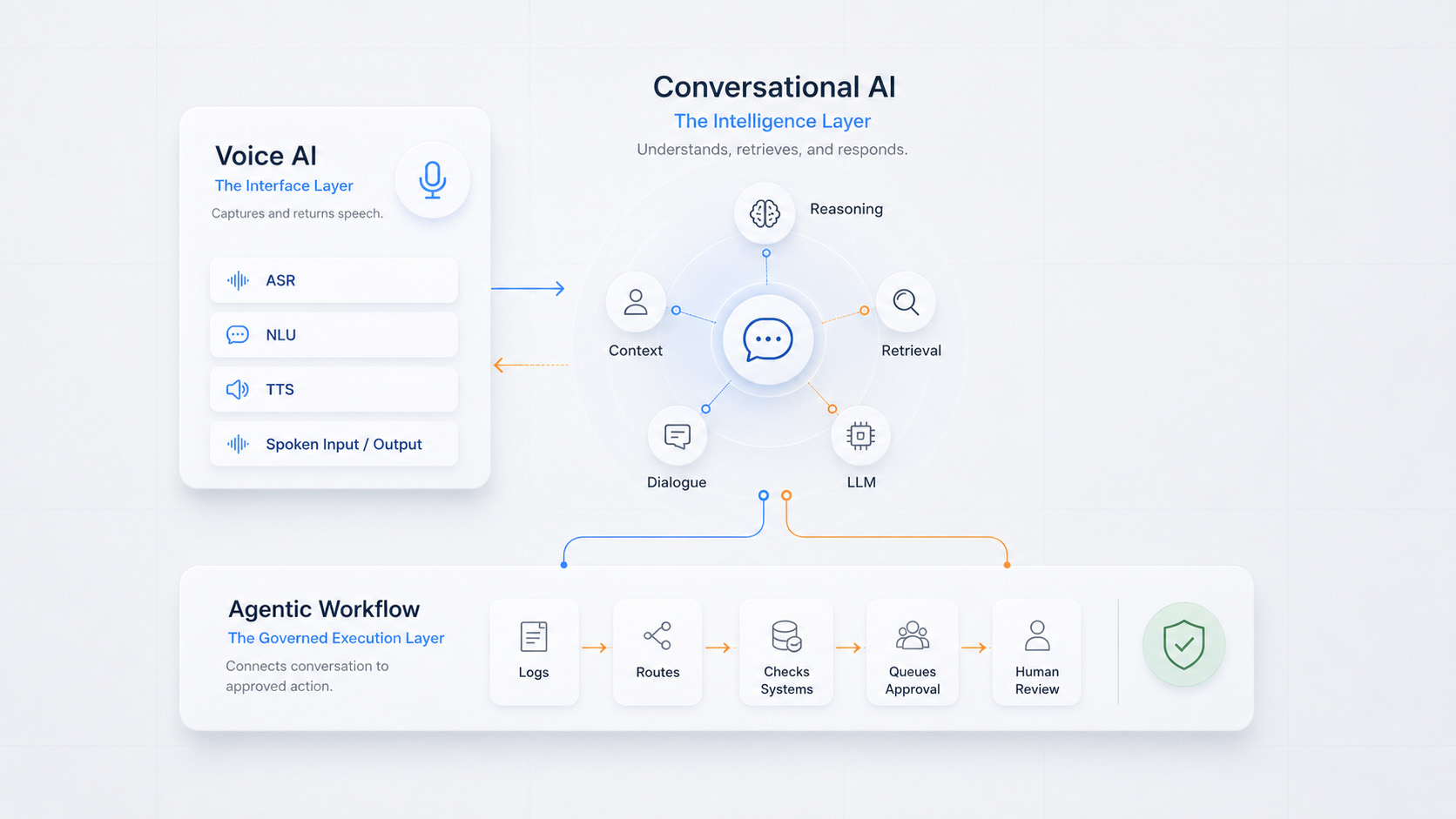
To build a sustainable strategy, leadership teams need to clarify the difference between Voice AI, Conversational AI, and Agentic AI. Software vendors and enterprise architects often use these terms interchangeably. That creates misaligned expectations, poorly scoped projects, and avoidable system failures.
They are separate layers of the technology stack.
Voice AI is the interface.
Conversational AI is the intelligence layer.
Agentic AI is the governed workflow execution layer.
Understanding the distinction is critical for operations, commercial, IT, data, customer experience, and compliance leaders evaluating these investments.
Voice AI allows humans and computers to communicate using natural speech rather than screens, keyboards, or complex mobile applications. It is the input and output mechanism.
In an enterprise context, Voice AI relies on three core components operating in real time.
Automatic Speech Recognition, or ASR, translates spoken words into text. Consumer ASR may be built for quiet living rooms or mobile devices. Enterprise ASR has to handle far more variability.
In a business context, ASR may need to handle:
Voice can be the lowest-friction interface in environments where typing slows the work. In operational settings where workers are wearing protective equipment, handling sterile materials, operating machinery, or moving through a facility, a screen-based interface may be a barrier. Voice can reduce that barrier when it is implemented safely.
Once speech is converted into text, Natural Language Understanding, or NLU, parses the request to determine the user’s intent.
It does not just read the words. It determines what the person wants to accomplish.
For example, these three requests may all represent the same operational need:
A useful system needs to recognize the intent, extract the relevant entity, identify the location or asset, retrieve the right information, and route the request to the correct workflow.
Text-to-Speech, or TTS, converts the system’s response back into audio. Modern TTS can produce more natural cadence, pronunciation, and tone than earlier robotic systems.
But the enterprise issue is not whether the voice sounds human. The issue is whether the response is accurate, approved, appropriate for the context, and useful in the workflow.
If Voice AI is the interface, Conversational AI is the intelligence layer that processes the request.
Conversational AI uses language models, natural language processing, retrieval systems, dialogue management, and workflow logic to understand intent, maintain context, ask clarifying questions, retrieve information, and provide a useful response.
Unlike legacy IVR phone trees or rigid chatbots, conversational AI can handle non-linear interactions. A user does not have to follow a predefined menu. The system can interpret the request, maintain context across multiple turns, and retrieve relevant information from approved sources.
The goal is not human-likeness. The goal is usefulness.
A conversational AI system should help people complete a task, answer a specific question, reduce friction, or move a workflow forward. If it only mimics conversation without improving the work, it is a novelty.
Most organizations are still stuck at the legacy chatbot stage. They view conversational tools as isolated support widgets rather than workflow infrastructure. Moving beyond that stage requires clear workflow selection, approved knowledge, system integration, governance, and measurement.
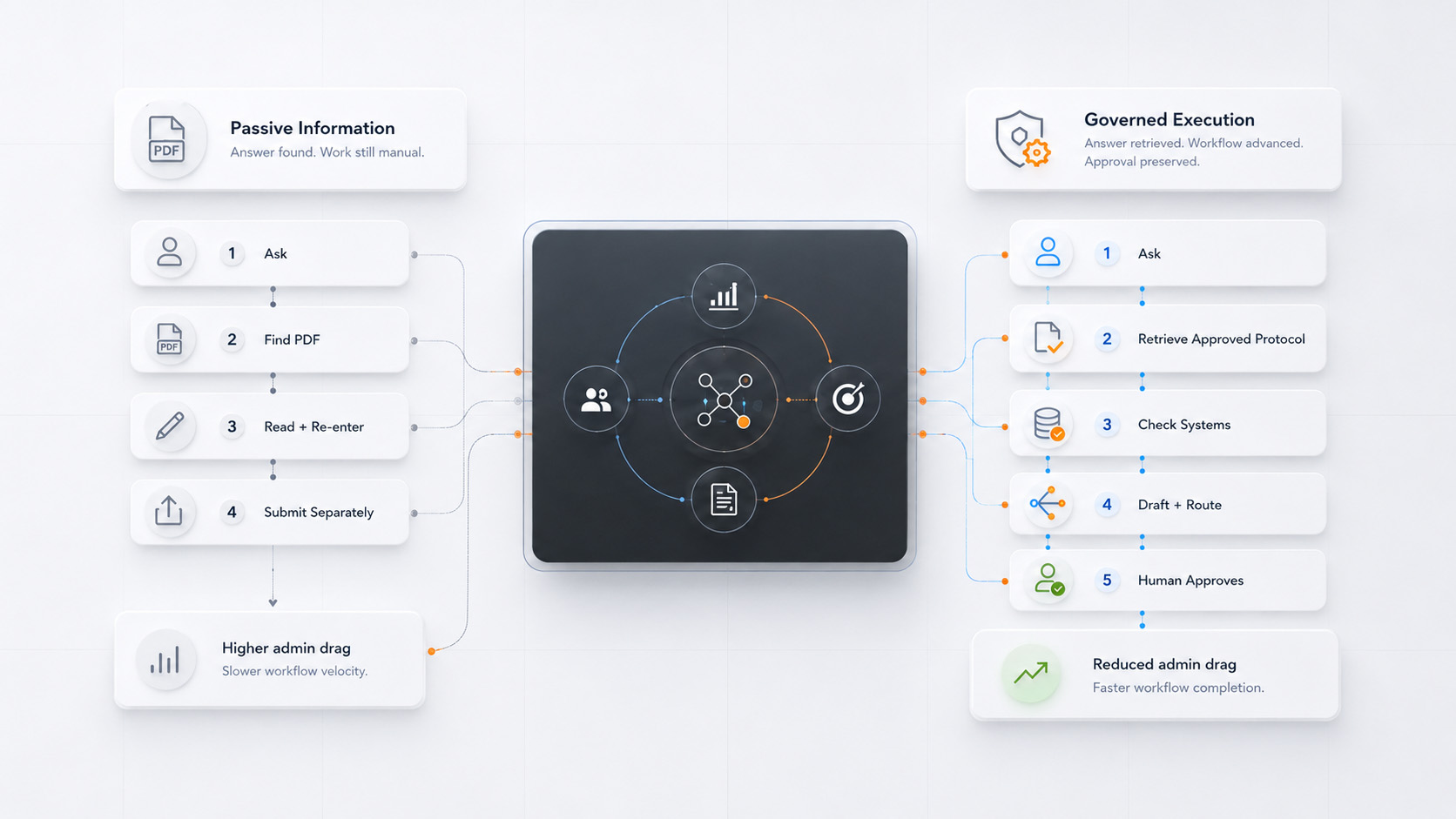
The most important development for mid-market operators is the shift from conversational systems that only answer questions to agentic workflows that can execute bounded tasks.
Historically, digital assistants were mostly informational. A user asked a question and the system returned a document, link, answer, or next-step suggestion. Agentic AI shifts the focus from retrieving information to supporting governed task execution.
The value is not the AI’s ability to mimic human thought. The value is the system’s ability to connect a request to approved knowledge, business rules, system actions, and human approval points.
Consider the difference in a field-service environment.
A field technician asks, “What is the maintenance protocol for HVAC unit model 400?”
The system pulls up a 200-page PDF on a tablet. The technician stops working, searches the document, diagnoses the issue, opens a separate application, manually types the repair log, and submits a parts request in another system.
The technology answered the question, but the workflow remained fragmented.
The technician says, “HVAC unit 400 is reporting error code 7B.”
The system responds: “Error 7B indicates a compressor relay failure. I found the approved protocol, logged the error code in the CMMS draft record, checked regional inventory for the replacement relay, and queued a purchase request for supervisor approval. Should I notify the facility manager about the estimated downtime?”
In a governed deployment, the system should queue actions, apply policy constraints, and escalate approval decisions rather than silently completing high-risk steps.
This is where business value begins to show up. The workflow is shorter. Manual steps are reduced. The source knowledge is approved. The system is integrated with the CMMS, ERP, inventory, or customer system. Human review remains visible where risk requires it.
The shift to agentic workflows does not remove the need for people. It changes where people add value. Humans remain responsible for judgment, approval, exceptions, governance, and accountability. The system reduces unnecessary manual steps so people can focus on higher-value work.
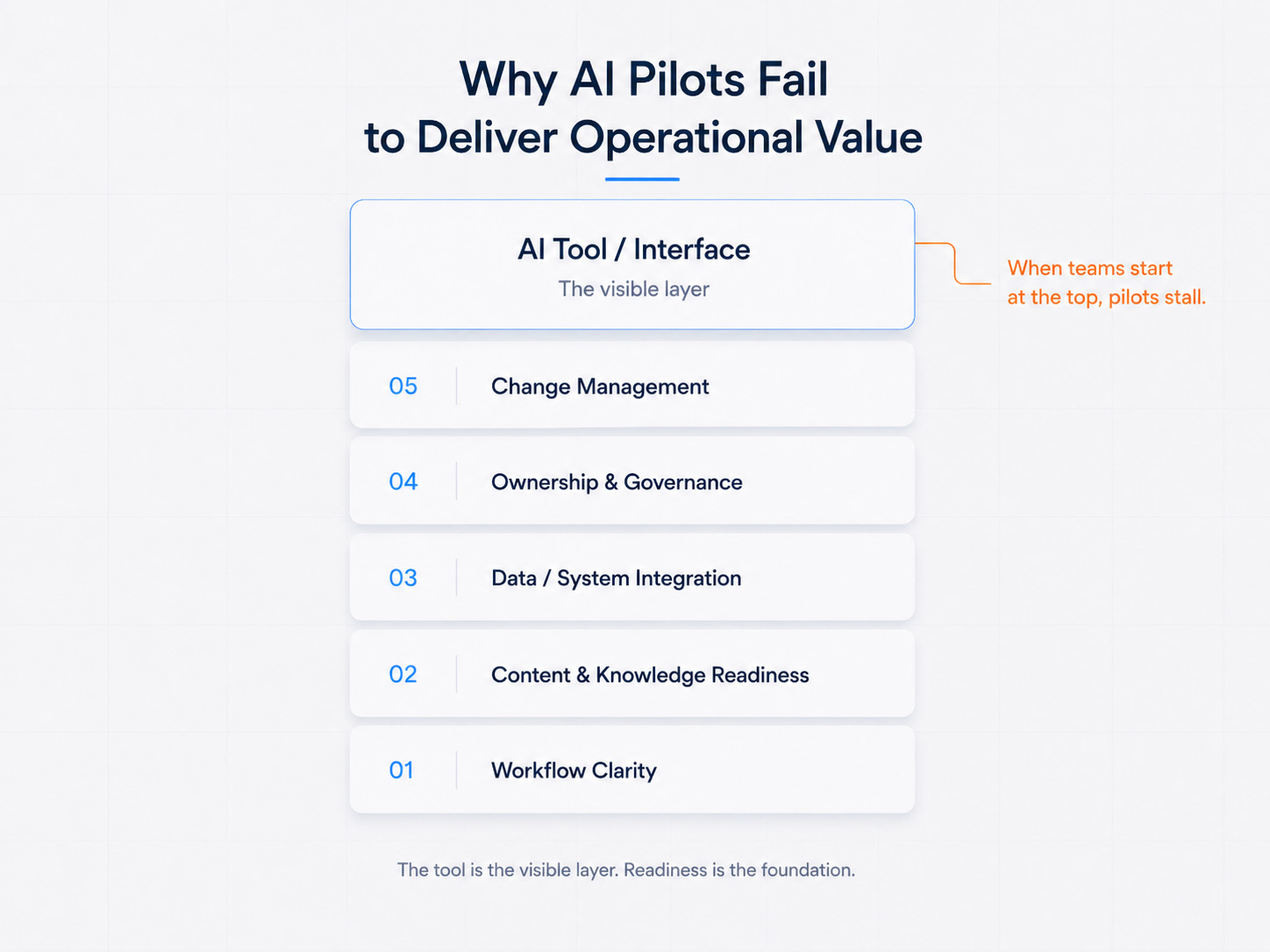

Most failed initiatives do not fail because the model is weak. They fail because the workflow, data, ownership, or governance conditions are not ready.
The Pragmatic AI Pre-Flight Check helps leadership teams identify the blockers that could stall AI-enabled execution before they spend another quarter funding the wrong pilot.
Understanding the technology stack is only the baseline. The real challenge is organizational execution.
We see a consistent pattern. A company buys a conversational AI platform, embeds it on a website or employee portal, and waits for efficiency gains. Six months later, adoption is flat, answers are inconsistent, users do not trust the system, and the project is quietly abandoned.
Most initiatives fail because of structural missteps, not software limitations.
A governed AI system cannot fix a broken process. It will only execute a broken process faster.
Many companies deploy conversational AI without first mapping the high-friction workflow they are trying to improve. If you cannot document the exact steps a human takes to resolve an issue today, which screens they check, which policies apply, what exceptions are allowed, and which systems of record must be updated, you cannot build a reliable automated workflow.
You end up with a tool that routes users to generic FAQs, escalates too often, or produces answers no one trusts.
Workflow clarity must precede automation.
A conversational interface that is not integrated into core business systems provides limited operational value.
If a customer-facing chatbot can answer basic questions about business hours but cannot look up order status, product availability, claim status, safety documentation, or approved instructions, it creates a dead end.
To be effective, the system must act as an orchestration layer. It needs appropriate API connectivity, data access, retrieval rules, permissions, and logging so it can securely read from and, where appropriate, write to approved systems.
Who owns the system after it goes live?
IT may manage infrastructure. Marketing may own brand voice. Operations may own workflow outcomes. Legal, security, compliance, quality, or medical teams may own risk boundaries. Data teams may own source systems.
Because conversational AI touches multiple functions, it often becomes orphaned.
An AI system requires continuous ownership. Someone has to review conversation logs, evaluate failed responses, update approved source content, tune escalation logic, monitor risk, and identify new opportunities.
Without clear ownership, quality degrades quickly.
A voice AI system in manufacturing can be technically elegant and still fail if frontline workers view it as surveillance, extra work, or a threat to their jobs.
Mid-market leaders often underestimate the human element of AI deployment. Successful execution requires transparent change management. People need to understand how the tool helps them, where human review remains in place, what data is captured, and how the system changes daily work.
Adoption improves when the system removes tedious tasks, reduces trips across the facility, improves access to information, or prevents repeated manual entry. It declines when employees believe the system is being imposed without context.
Many companies buy proprietary, closed-ecosystem AI tools that do not let them own their conversational data, export their workflows, or control their knowledge layer.
If the vendor changes pricing, limits integrations, weakens its roadmap, or fails to meet compliance needs, the organization is trapped.
A pragmatic strategy requires building content, workflow logic, governance rules, and source knowledge in a vendor-aware but vendor-resilient environment. The organization should maintain control over its enterprise knowledge and decision logic regardless of which model, interface, or orchestration layer is used.
An AI system is only as reliable as the knowledge it consumes.
Pointing an LLM at an unmanaged intranet filled with outdated PDFs, contradictory policies, duplicate product manuals, and obsolete training materials will create confident but incorrect answers.
If the underlying content is unstructured and ungoverned, the AI output becomes a liability.
Content and knowledge readiness are foundational to AI readiness.
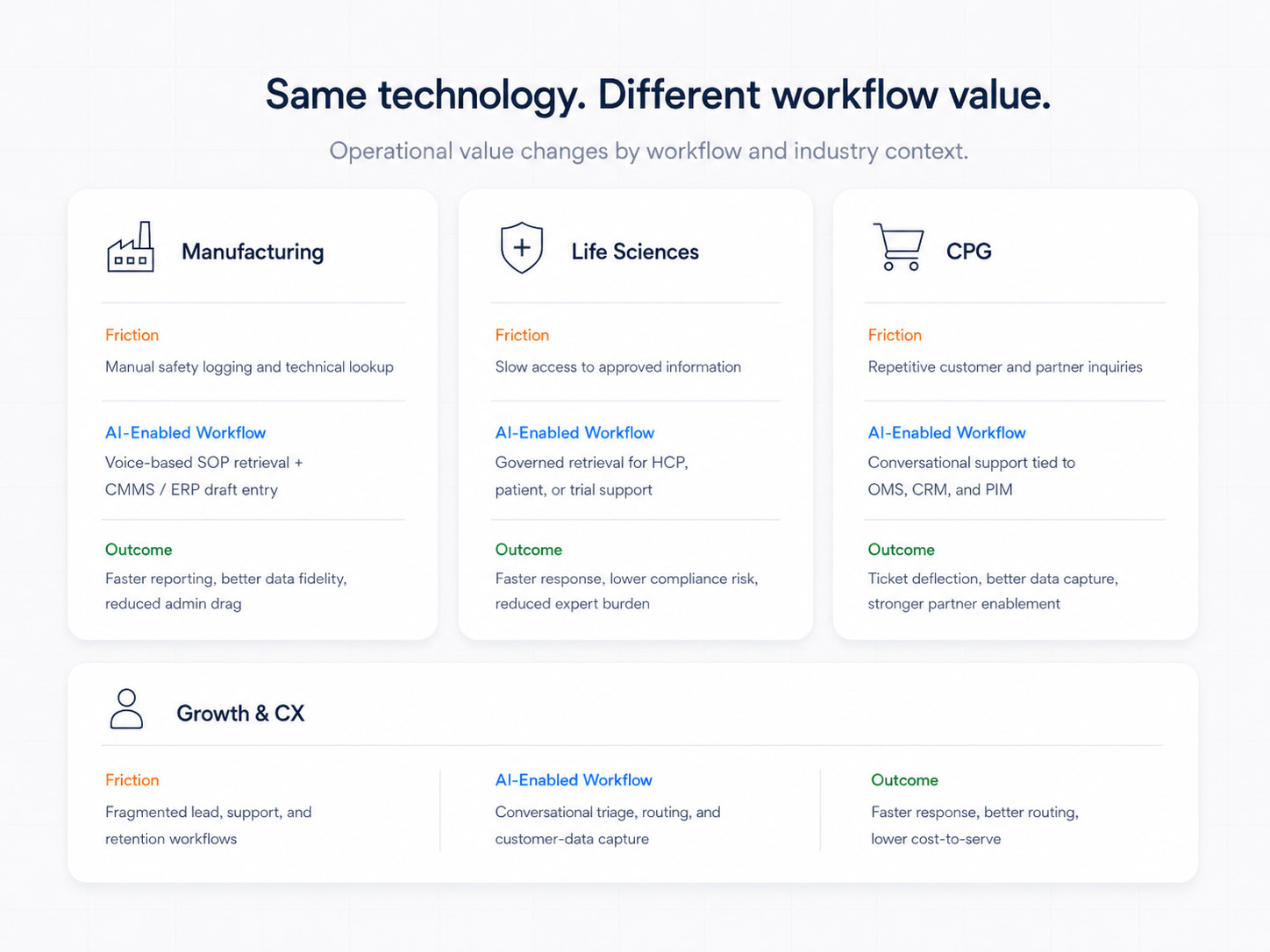
With the common failure points in mind, the next question is practical: where does governed conversational AI create measurable value?
The highest returns usually come from targeted, high-friction workflows where complexity, volume, and business consequence are high. The goal is not broad deployment. The goal is to identify the workflow where voice or conversational AI can reduce friction, improve accuracy, speed up a process, or make approved knowledge easier to use.
For mid-market and PE-backed organizations, the strongest opportunities often appear in Manufacturing, Life Sciences, CPG, Growth and CX, and other regulated or workflow-heavy environments.
Manufacturing environments are physical. Workers manipulate materials, operate machinery, follow safety requirements, and move between systems. Forcing a worker to walk across a facility, remove gloves, log into a terminal, and type data into an ERP or quality system creates operational waste.
Voice and conversational AI can support manufacturing workflows when the system is connected to approved SOPs, asset data, ERP, MES, SCADA, CMMS, inventory, quality documentation, and escalation paths.
Technicians performing maintenance on machines or lines can use a voice-enabled system to request schematics, torque specifications, inspection steps, safety protocols, or error-code guidance while they remain in the work environment. The system retrieves approved data points from the right source rather than forcing the technician to search physical manuals or static PDFs.
Instead of filling out paper forms at the end of a shift, workers can dictate logs in real time. The system structures the input, categorizes the issue, and pushes a draft or approved entry into the CMMS or quality workflow. For critical hazards, it can trigger immediate escalation.
A floor manager can verbally query the warehouse management system to locate raw materials, parts, or inbound shipments. Instead of walking to a terminal, the manager asks, “Where is the shipment of 304 stainless steel?” The system queries approved inventory data and reports location, status, or estimated arrival time.
The business impact: reduced downtime, better safety and quality logs, faster onboarding, fewer manual data-entry errors, and improved productivity by removing administrative friction.
Related resource: AI for Manufacturing
In Life Sciences, the cost of non-compliance is high. Conversational AI cannot be treated as a generic answer engine. It must operate within approved claims, regulated documentation, escalation rules, audit expectations, and human review paths.
Governed systems can act as secure, auditable bridges between complex scientific or commercial information and the professionals who need it.
Healthcare professionals often need fast access to approved information about indications, contraindications, drug interactions, device usage, dosing guidelines, or supporting studies. A governed conversational interface can help them retrieve approved information and cite the exact source material, while routing complex or inappropriate questions to a human medical or support team.
Patients using complex therapies or medical devices often have routine questions. A conversational system can guide them through approved usage instructions, onboarding steps, or support content. If the patient reports an adverse event or asks for medical advice, the system should escalate to the appropriate human process rather than attempting to answer beyond its authorized boundary.
Clinical trials generate large volumes of protocol documentation. Site coordinators can use conversational interfaces to look up inclusion and exclusion criteria, visit schedules, dosing requirements, or adverse-event reporting protocols from approved documentation.
The business impact: improved access to approved information, reduced burden on highly specialized staff, more consistent field and support responses, and stronger control over claims, escalation, and auditability.
Related resource: AI for Life Sciences
For mid-market CPG brands, value is created by improving customer experience, protecting margin, supporting retail and distribution partners, and capturing useful first-party or zero-party data without creating brand or compliance risk.
Conversational AI can help when it is integrated into order management, CRM, PIM, ecommerce, loyalty, support, and marketing automation systems.
Instead of forcing customers to wait for simple questions, an integrated system can handle “Where is my order?” requests, initiate returns, process warranty claims, or retrieve product usage guidance by connecting to order management and logistics systems.
During a natural interaction, such as helping a customer select a skincare, nutrition, household, or specialty product, the system can ask approved questions and capture structured preferences. That data can support downstream segmentation, lifecycle marketing, and product insights when privacy and consent requirements are followed.
CPG companies manage networks of retailers, wholesalers, brokers, distributors, and sales partners. These partners often need order status, invoice details, promotional guidelines, product information, sell sheets, or localized guidance. Conversational AI can automate routine retrieval and free account teams to focus on strategic growth.
The business impact: deflection of low-complexity support tickets, richer customer data profiles, more efficient B2B partner support, and faster access to approved product and retail information.
Related resource: AI for Consumer Packaged Goods
Across sectors, the pattern is consistent. Value comes from applying conversational AI to well-defined, high-friction workflows with clear ownership, approved knowledge, and measurable outcomes.
Achieving these outcomes at scale requires more than selecting the right use case. It requires a shift in how organizations approach the technology itself.
Most companies begin by buying tools. The organizations that see sustainable results move from buying tools to building governed systems.
This transition depends on three operational shifts.
You need to dissect the workflow before automating it.
What is the exact conversational trigger? What specific data does the system need to retrieve? What APIs or systems must be queried? What are the edge cases? What should the system never do? Where does a human need to approve, review, or take over?
Governed workflows are mapped before prompts are written or software is configured.
A strong workflow map should clarify:
Without this map, a conversational AI system becomes a polished interface over an unclear process.
An LLM needs clean, structured, approved context to function accurately in a business setting. You cannot point AI at a shared drive and expect it to work safely. Enterprise knowledge must be audited, cleaned, and structurally tagged.
This process may include:
Identify which manuals, SOPs, product documents, claims libraries, policies, scripts, training materials, knowledge-base articles, and system data are needed for the workflow.
Remove obsolete, duplicate, contradictory, or unapproved content. Identify gaps where no approved answer exists.
Break large PDFs, manuals, or policies into smaller, discrete units so the system can retrieve the exact information needed.
Tag content by product, audience, workflow, geography, risk category, approval status, date, and source owner.
Convert text into embeddings and design retrieval rules so user intent can be matched to the right approved source.
If source material is contradictory or duplicated, the system will produce inconsistent results. If source material lacks approval status, the system may retrieve content that should not be used.
To scale conversational AI safely, teams need a repeatable approach to managing data, prompts, workflow logic, approvals, and performance improvement.
This is the role of execution discipline. The model is only one part of the system. What determines usefulness is the operating model built around the system.
A production-grade conversational AI system needs:
The system should become more useful as the organization learns from failed responses, escalation triggers, unresolved questions, and repeated user needs.
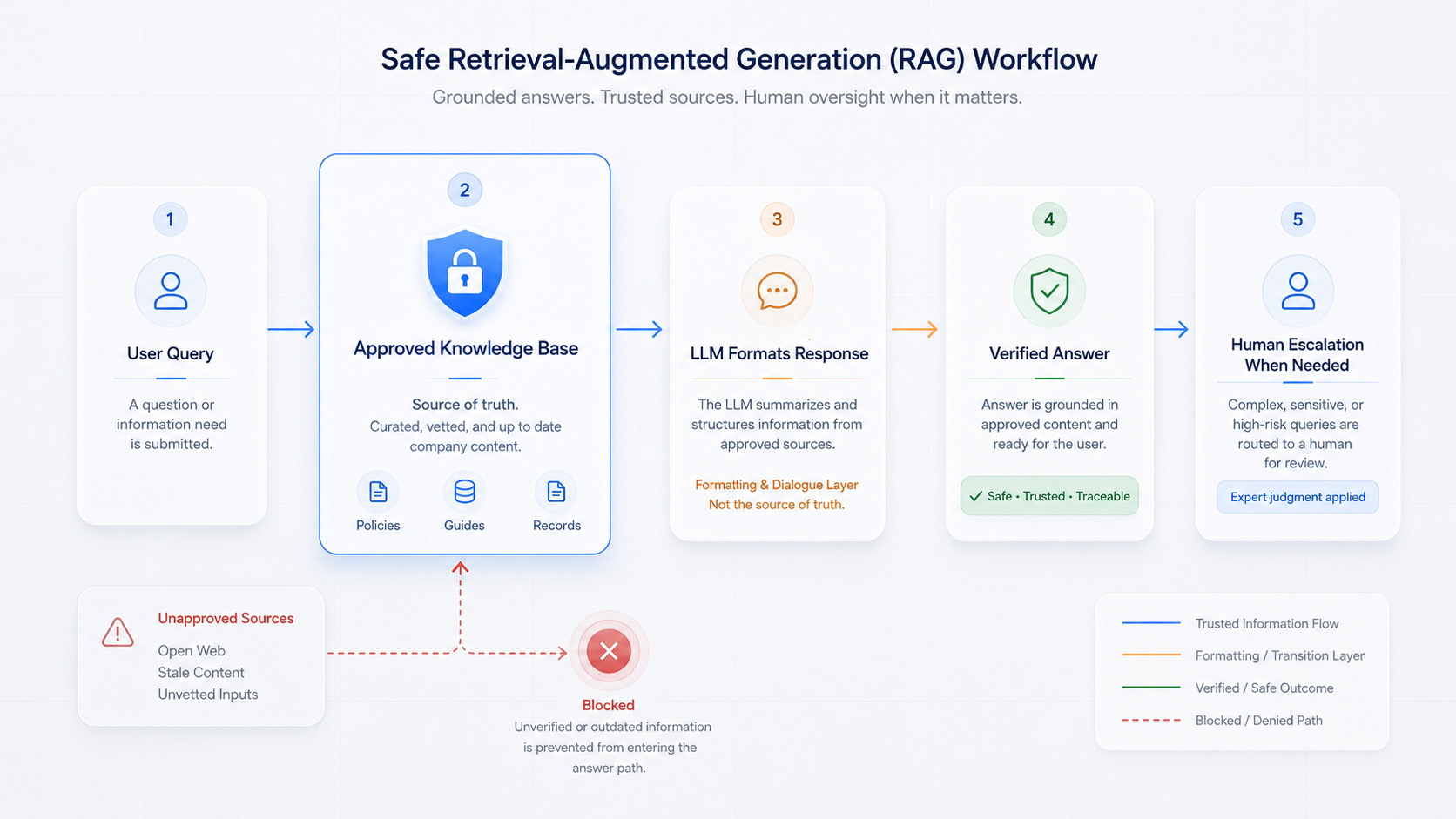
When you deploy voice and conversational AI, you are authorizing a digital system to respond, retrieve, route, or act on behalf of the organization.
That creates brand, compliance, operational, privacy, and security risk if governance is not designed into the system from the beginning.
Governance is not a speed bump. It is what allows the system to operate safely.
A conversational system should reflect brand standards consistently, but brand voice is only one part of governance.
More important are negative constraints: what the system is explicitly not allowed to say, answer, promise, recommend, approve, or execute.
For a Life Sciences company, the system must not offer diagnostic medical advice or make claims outside approved materials. For a manufacturer, it must not guess at a safety protocol. For a CPG company, it must not promise a promotion, return, or delivery status that is not verified.
Negative constraints should be documented and tested.
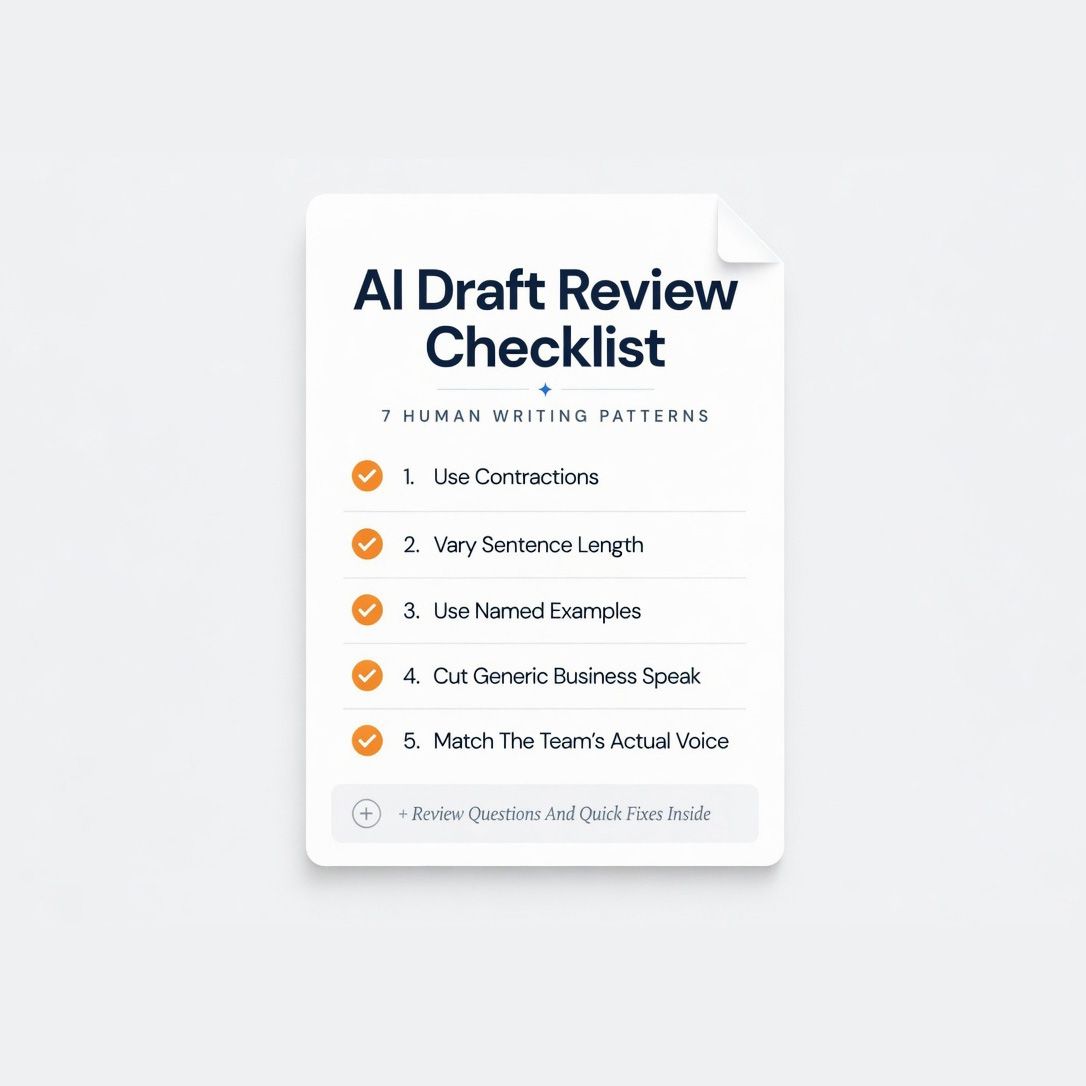
Get the 7-pattern review checklist we use to turn generic AI content into sharper, more specific, on-brand drafts before they hit an editor, client, or approver.
Get the Checklist NowNot a prompt pack. A practical review lens.
In a business context, guessing is unacceptable.
Good governance requires a retrieval architecture that limits the system to approved knowledge. Retrieval-Augmented Generation, or RAG, is one way to accomplish this.
What weak governance looks like: Uploading unedited PDFs into a database and allowing an LLM to summarize freely, using its general training data to fill in gaps.
What strong governance looks like: A user asks a question. The system retrieves the approved answer from structured source material. The language model formats that answer into a usable response. If the answer is not in the approved knowledge base, the system says it does not have approved information and escalates appropriately.
A governed system knows its limits.
Teams need to define explicit handoff triggers. If a user expresses frustration, asks for something outside the approved knowledge base, requests a high-value transaction, raises a safety issue, reports an adverse event, or enters a regulated topic, the workflow should escalate to a human.
The handoff should include context. The human should not have to ask the customer, technician, patient, or employee to repeat everything.
Conversational inputs can include personally identifiable information, protected health information, proprietary trade secrets, confidential pricing, employee data, customer data, or regulated information.
Governed systems need controls for:
Sensitive information should not be sent to an external model or tool without review and approval under the organization’s policies.
Before a system goes live, teams should intentionally test it under pressure.
Red teaming attempts to break the system. Testers may try prompt injection, disallowed requests, sensitive data extraction, policy bypasses, or attempts to force the model into unauthorized behavior.
This testing helps validate whether guardrails work under real-world conditions.

Before scaling any conversational interface, leadership should align on formal AI usage policies, source approval rules, escalation requirements, and measurement criteria. If those decisions are still unresolved, the right next step may be an Executive AI Briefing or AI Pre-Flight Check before a pilot is funded.
Strong governance and strong measurement go together.
Many organizations track surface-level metrics such as total conversations, sessions, or deflection. These metrics can be useful, but they rarely prove business value by themselves.
A more mature approach focuses on operational outcomes and uses system data to improve both the workflow and the underlying knowledge base.
Deflection means a user did not call support. Resolution means the user’s problem was actually solved.
If a user interacts with the AI, drops off, and calls support ten minutes later, the system did not resolve the issue even if the session was counted as completed.
Teams should track the full journey, not just the conversation.
Journey Velocity measures how quickly a customer, employee, partner, technician, or buyer can complete a specific task.
If a technician previously spent 14 minutes finding a manual and logging a repair, and the conversational workflow reduces that process to 3 minutes, the organization has created 11 minutes of operational capacity per ticket.
Multiply that by thousands of tickets, work orders, customer questions, or support issues, and the financial impact becomes measurable.
For commercial use cases, conversational AI can capture structured data directly from the user when consent and policy allow.
This might include preferences, timelines, budgets, symptoms, product needs, use cases, industry, role, purchase intent, or support context.
The value comes when that data is structured and passed into CRM, marketing automation, product, support, or analytics systems.
When the system hands a conversation to a human, leaders should ask why. Common escalation reasons include:
Escalation analysis shows which workflows need refinement and which documents, policies, or data sources need improvement.

Moving from a static digital presence to a conversational one requires more than a software installation. It requires a shift in design philosophy.
At Pragmatic Digital, our approach is grounded in the principle that conversational interfaces should be useful, usable, governed, and connected to a real operating outcome.
This perspective comes from years of work in conversational AI, voice strategy, content systems, customer experience, and enterprise adoption. It is also reflected in Susan and Scot Westwater’s published work on voice and conversational AI.
An AI interface must provide more than novelty. It must provide utility.
Useful: Does the conversational system solve a high-value problem for the user at a specific point in their journey?
Examples include:
Usable: Can the person complete the interaction without friction, confusion, or repeated loops?
A system is not usable if it misunderstands intent, traps the user in scripted flows, escalates without context, or produces answers that need to be checked manually every time.
We do not design for abstract users. We design for people in context.
A manufacturing operator, patient, provider, distributor, compliance reviewer, sales engineer, procurement officer, or customer support agent each has different needs, constraints, vocabulary, systems, risks, and success measures.
A useful conversational system respects that context.
It should know what information the person is authorized to access, what language is appropriate, what workflows are available, what actions are permitted, and when human review is required.
Transformation does not begin with a platform purchase. It begins with identifying the single most valuable workflow or conversation where AI can reduce friction without creating unowned risk.
That workflow should have:
If the workflow does not meet those conditions, the organization may need readiness work before implementation.
The mid-market organizations that will see real operational ROI are the ones that treat conversational interfaces as governed workflow systems, not standalone tools.
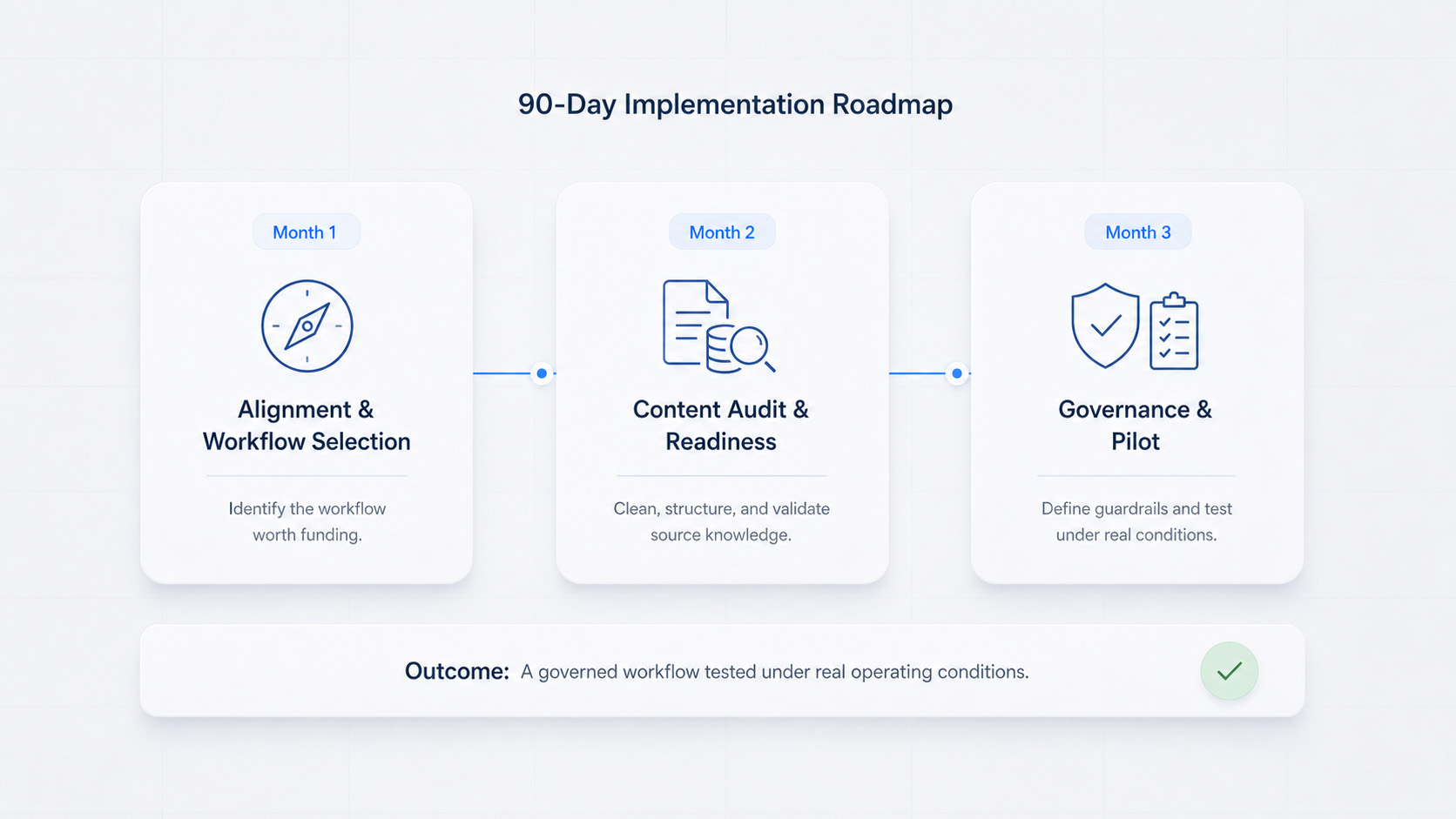
If your team is ready to evaluate a production-grade workflow, use a disciplined 90-day path.
Start by pausing vendor selection. Software is not the first decision. Workflow selection is. Bring the relevant commercial, operational, technical, data, risk, and executive stakeholders together. Identify a single high-volume or high-consequence workflow that creates measurable drag.
Document the current state:
The goal of the first 30 days is not to pick a tool. It is to identify the workflow worth funding.
Once the workflow is selected, gather the content, data, policies, SOPs, scripts, product information, training materials, and business rules required to support it.
Audit the source material:
This is where many initiatives discover that the organization is not ready for conversational AI because the knowledge base is not ready.
The goal of days 31–60 is to determine whether the system has a clean, governed knowledge foundation.
Before piloting, define the guardrails.
This includes:
Then test the workflow with a narrow group of users. Use real inputs. Try to break the system. Review failed responses. Refine the workflow, retrieval logic, prompts, escalation rules, and source content before expanding access.
The goal is not a flashy pilot. The goal is a governed workflow that can survive real operating conditions.
Voice and conversational AI are not valuable because they are new. They are valuable when they reduce friction in a workflow that matters.
The organizations that benefit will not be the ones that buy the most tools. They will be the ones that identify the right workflow, structure the right knowledge, define the right guardrails, and measure the right outcomes.
For mid-market and PE-backed companies, this matters because AI investment is already consuming budget, executive attention, and team capacity. Every poorly scoped tool, disconnected chatbot, or ungoverned assistant creates drag instead of leverage.
The practical question is simple:
Which conversational AI workflow is worth funding first, and what has to be true before it can operate safely?
If your leadership team can answer that question, you are ready to move from experimentation to accountable execution. If not, the next step is not another demo. It is diagnostic clarity.

If your team is evaluating voice, conversational, or agentic AI, the next step is not another tool demo. It is a clear view of your workflow, data, governance, and ROI conditions.
Apply for an AI Readiness DebriefQuestions teams usually ask before starting.

Weekly insights on AI adoption, workflow, and what's actually working in mid-market organizations.

