DIGITAL MARKETING
May 14, 2026

Best AI Advertising Campaigns 2026 | Case Studies That Actually Worked

The brands winning with AI advertising aren’t just running more ads. They’re running campaigns inside governed, repeatable systems. Here’s what that looks like in practice.

The brands winning with AI advertising in 2026 aren’t the ones with the newest models. They’re the ones who built the right system around them.

AI advertising has moved from “cool demo” to “board-level expectation.”

The brands winning in 2026 aren’t just running more AI-generated ads. They’re running campaigns inside governed, repeatable systems that protect brand voice, reduce revision cycles, and deliver measurable ROI.

This post highlights real AI advertising campaigns from the past 18 months that actually moved the needle on performance, efficiency, or customer experience.

What Separates Winning AI Ad Campaigns from the Rest

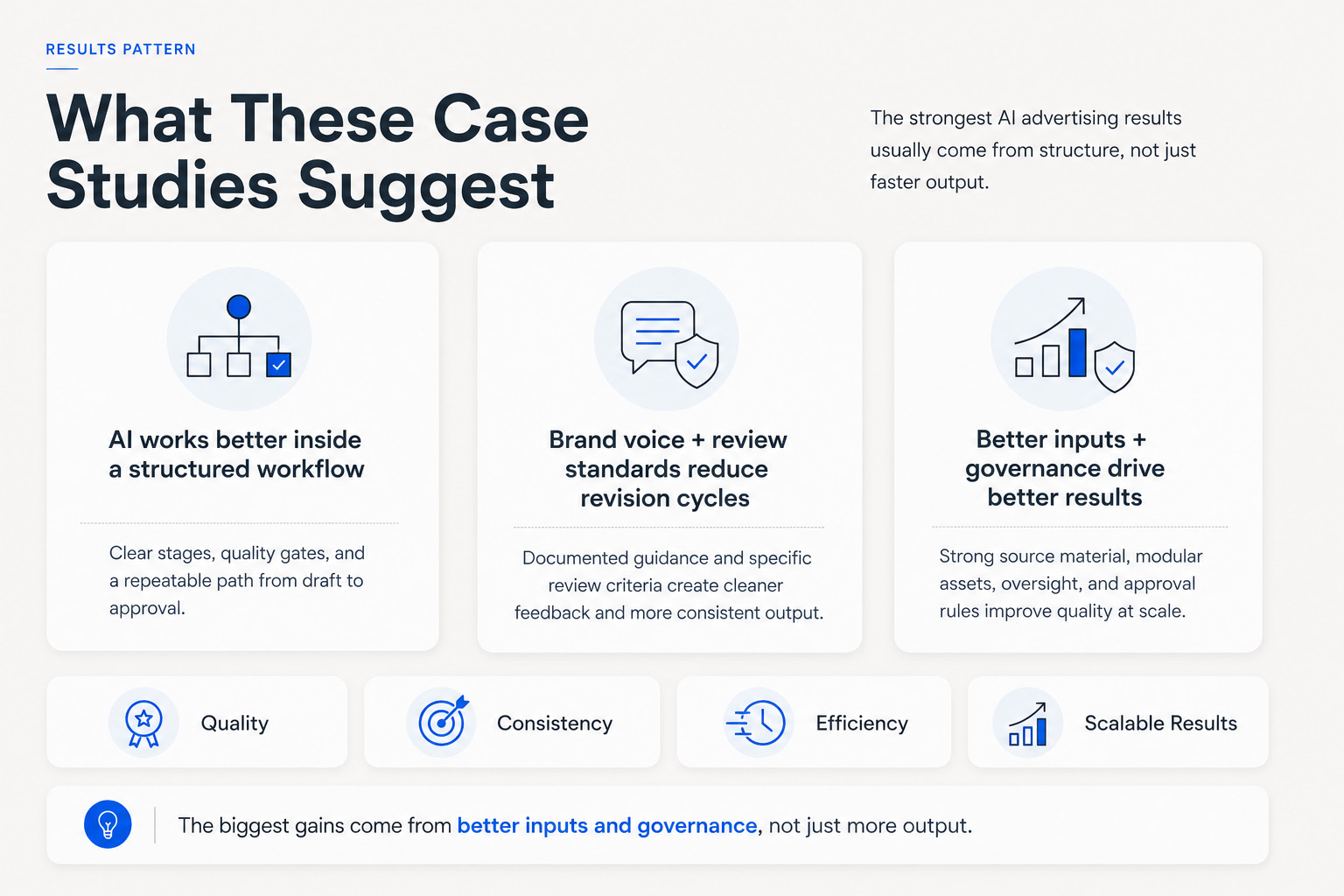
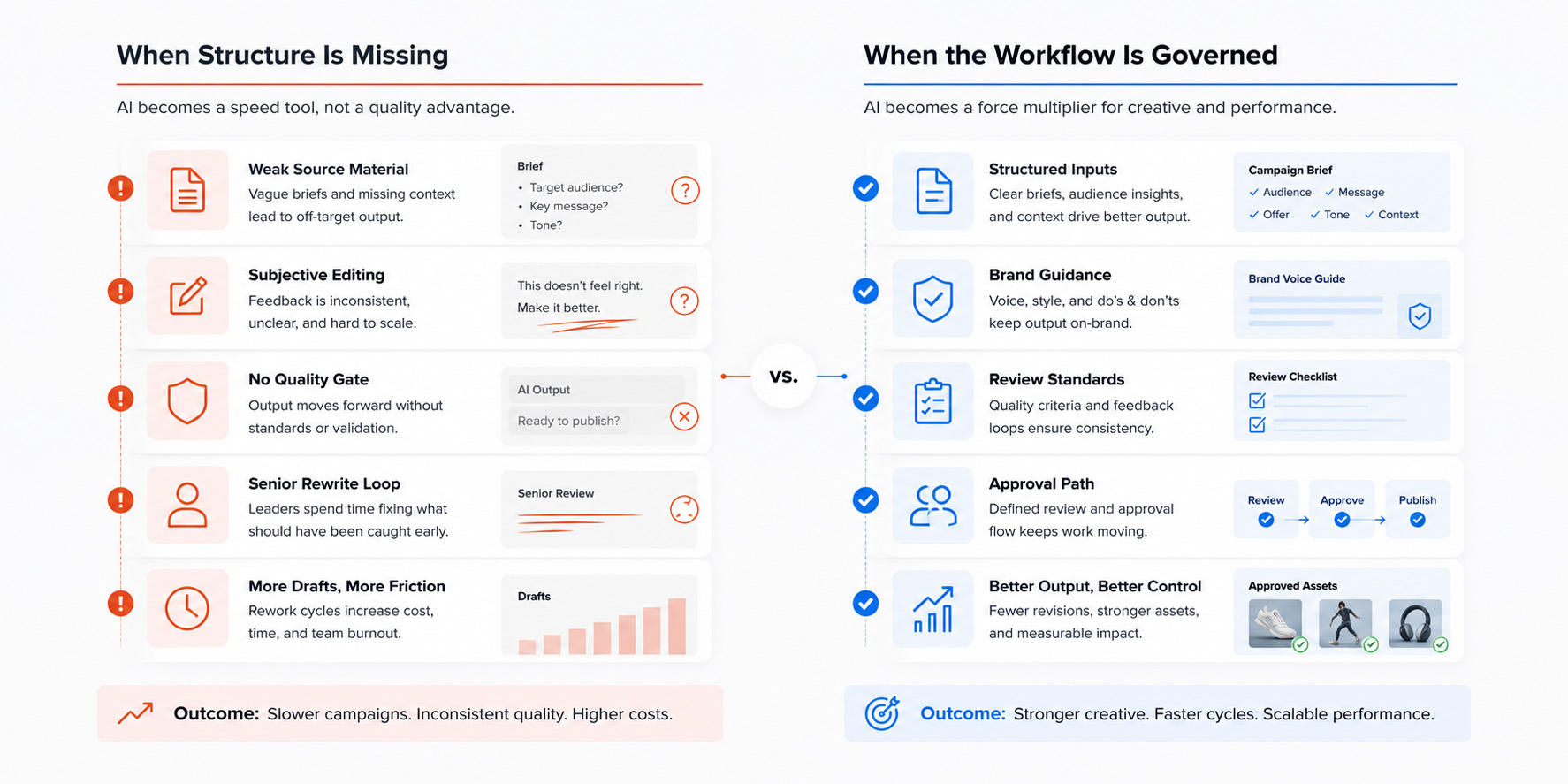
Most AI advertising experiments fail because they focus on speed and volume instead of structure and governance.

The campaigns that succeed consistently do three things well:

  • Start with clear brand standards and source material
  • Use structured, repeatable creative workflows
  • Keep humans focused on strategy and final judgment

Real AI Advertising Case Studies That Delivered Results

The following campaigns represent the clearest examples of AI advertising done right — with real outcomes, repeatable principles, and clear lessons for teams building their own systems.

The New Wave of AI in Advertising (2025 Examples)

The latest AI advertising examples aren’t just about data — they’re about tangible operational, financial, and customer engagement leverage. Here’s what leading brands are doing right now, and what it means for you.

1. Virgin Voyages: AI-Powered Personalization That Drives Loyalty

The Campaign: Virgin Voyages’ “Jen AI” campaign used a virtual Jennifer Lopez to create personalized, interactive cruise invitations.

AI in Action: AI generated bespoke video content at scale, making every customer feel like they got a personal invite from J.Lo herself.

The Strategic Takeaway for You: This is about turning personalization into retention. AI allows you to create high-touch experiences that deepen brand affinity and increase customer lifetime value (LTV). This is a prime example of a Conversational AI strategy that feels human and drives connection.

2. Burger King: AI-Powered Co-Creation & Engagement

The Campaign: The “Million Dollar Whopper Contest” invited customers to design their own Whopper using an AI-powered tool that created unique visuals and jingles.

AI in Action: The AI acted as a creative partner, instantly turning customer ideas into shareable assets that fueled social buzz.

The Strategic Takeaway for You: Turn your customers into your creative department. AI-driven co-creation fosters deeper loyalty and generates massive organic reach at a fraction of the traditional campaign cost.

3. Kalshi & Coign: High-Impact Video Creative on a Startup Budget

The Campaigns: Financial services brands Kalshi and Coign launched fully AI-generated commercials, with Kalshi’s ad even airing during the NBA Finals stream.

AI in Action: Produced in under 48 hours using tools like Google’s Veo 3 and OpenAI’s Sora, for less than 1% of typical production costs.

The Strategic Takeaway for You: Your new media budget weapon. By slashing production costs, you can reallocate funds to distribution and strategic experiments, leveling the playing field with bigger competitors.

4. H&M: AI Digital Twins for Scalable Global Creative

The Campaign: H&M created AI-powered “digital twins” of real models to scale global advertising production.

AI in Action: Generative AI produced thousands of consistent, high-quality model images, eliminating the logistical chaos and expense of global photoshoots.

The Strategic Takeaway for You: Decouple creative from physical limits. More assets, faster personalization, and lower costs — enabling more frequent testing and higher campaign ROI.

5. British Council: AI for Mass-Scale Localization & Efficiency

The Campaign: The British Council needed to localize over 1,000 ad assets across seven languages.

AI in Action: Using AI design automation tools like Creatopy, regional teams adapted creative templates independently and at speed.

The Strategic Takeaway for You: Unlock extreme operational leverage. AI-driven localization dramatically reduces costs and frees resources for higher-impact strategic activities. These are the kinds of wins we help teams identify in our hands-on AI workshops.

Blueprints That Still Win: Foundational AI Case Studies

These campaigns established the core principles of AI-driven advertising that are still essential for any leader’s playbook today.

6. Lexus: AI to De-Risk Creative & Accelerate Ideation

The Campaign: Lexus launched a bold experiment: an AI-written script for a luxury car commercial.

AI in Action: AI analyzed thousands of award-winning ads to learn emotional resonance and craft a unique, compelling narrative.

The Strategic Takeaway for You: Use AI to validate and accelerate the creative ideation process. It allows your team to test concepts and narrative angles faster, reducing the risk and cost of unproven creative directions.

7. Mouldy Whopper — Brand Authenticity & Risk as Differentiation

The Campaign: Burger King’s “Mouldy Whopper” campaign showed their flagship burger slowly decomposing over 34 days to emphasize the brand’s commitment to no artificial preservatives.

AI in Action: While not originally AI-driven, this campaign serves as a blueprint for how bold, authentic creative ideas can now be accelerated and validated with AI tools — from predictive creative testing to AI-powered concept development and rapid content variations for global markets.

The Strategic Takeaway for You: Take strategic risks that reinforce your brand promise. With AI, you can stress-test provocative creative ideas before launch, iterate on them quickly, and scale authentic storytelling globally. Great creative still wins — AI just lets you de-risk and multiply it.

8. Harley-Davidson — AI to Transform Local Sales & Marketing ROI

The Campaign: Harley-Davidson NYC used an AI-powered marketing platform (Albert.ai) to automate and optimize their digital advertising across channels.

AI in Action: The AI dynamically adjusted targeting, creative, and spend allocation in real time based on performance signals. This resulted in a 2,930% increase in leads and a 40% decrease in cost per lead — outcomes that would have been impossible to achieve manually at this scale and speed.

The Strategic Takeaway for You: AI can act as a fully autonomous growth engine, driving immediate revenue results. Beyond creative, think about AI as a force multiplier for your paid media and demand generation strategy.

9. Under Armour: AI to Eliminate Wasted Ad Spend

The Campaign: Under Armour’s “Rush” campaign used AI to personalize messaging based on past customer behavior.

AI in Action: AI analyzed customer data to deliver hyper-targeted ads, connecting benefits to those most likely to convert.

The Strategic Takeaway for You: Trade shotgun for laser. AI targeting dramatically lowers Customer Acquisition Cost (CAC) and boosts ROI by focusing on the right people with the right message.

10. Spotify: AI as a Retention Engine

The Campaign: Spotify’s personalized playlists, like “Discover Weekly,” revolutionized user engagement.

AI in Action: Spotify’s algorithms analyze listening habits to create hyper-personalized weekly playlists — an approach so successful it became a globally recognized benchmark for AI-driven customer loyalty.

The Strategic Takeaway for You: Think beyond campaigns. AI can be woven into your core product or service to create a powerful, indispensable retention engine that keeps customers locked in.

11. The North Face: AI to Solve Customer Friction & Boost Sales

The Campaign: The North Face introduced an AI-powered shopping assistant to simplify product selection.

AI in Action: Customers answer a few guided questions, and the AI narrows down options to find the perfect fit.

The Strategic Takeaway for You: Find the biggest friction point in your buyer journey. AI assistants and voice AI can solve it, directly boosting conversions and average order value (AOV).

12. Amaysim & Toys ‘R’ Us: AI for Speed-to-Market Dominance

The Campaign: Amaysim and Toys ‘R’ Us rapidly launched campaigns using AI creative tools.

AI in Action: Teams leveraged AI video and image generation tools like Adobe Firefly and Runway to condense production from months to days.

The Strategic Takeaway for You: Speed is the new competitive moat. AI empowers your team to move at market speed, quickly testing ideas while competitors are still storyboarding. For leaders ready to build this capability, our Workflow Optimization Pilot is designed for exactly this.

2024–2026: Fresh Benchmarks in AI-Driven Campaigns

The following five campaigns represent the most instructive recent examples of AI-driven advertising and marketing — each demonstrating not just creative ambition, but measurable business outcomes and, in most cases, the kind of governed, repeatable system thinking that separates durable advantage from one-time results.

13. Klarna: AI Customer Assistant That Replaced 700 Agents

The Campaign: Klarna deployed an AI-powered customer service assistant across its global customer communications operation, handling everything from order inquiries to dispute resolution. The initiative was not a chatbot pilot — it was a production-grade, governed replacement for a significant portion of the company’s customer service function.

AI in Action: The AI assistant, built on OpenAI technology, was integrated directly into Klarna’s customer service infrastructure and trained on its policies, workflows, and brand voice standards. It operated across 23 markets and 35 languages, handling the work previously done by approximately 700 full-time agents while maintaining real-time escalation paths to human agents for complex cases.

Results & Impact: Klarna reported that the AI assistant handled two-thirds of all customer service chats within its first month of full deployment, roughly 2.3 million conversations. Average resolution time dropped from 11 minutes to under 2 minutes. Customer satisfaction scores remained on par with human agents. The company estimated $40 million in annual profit improvement from the initiative.

Strategic Takeaway for Readers: The Klarna case is the clearest recent example of the gap between AI experimentation and AI as a governed operating system. The result didn’t come from deploying a chatbot, it came from building source material standards, integration with existing systems, explicit escalation protocols, and ongoing performance monitoring into the workflow from day one. For mid-market and PE-backed teams, the lesson is sequencing: governance design before scale, not after.

14. Coca-Cola: Create Real Magic Generative AI Platform

The Campaign: Coca-Cola launched “Create Real Magic,” a consumer-facing generative AI platform that invited fans and creators worldwide to produce original artwork using the brand’s iconic visual assets, characters, and creative history. The campaign spanned multiple activation phases, including a creator residency in Atlanta and New York and integrations with major brand moments.

AI in Action: Built in partnership with OpenAI and Bain & Company, the platform combined GPT-4 and DALL-E capabilities with a curated library of Coca-Cola’s brand assets, including iconic imagery, characters, and design elements. Critically, the AI operated within defined brand guardrails: users could create freely, but the system was structured to prevent off-brand or inappropriate outputs. A human curation layer selected standout work for official brand use.

Results & Impact: The platform generated significant earned media and social engagement across launch markets. Thousands of creator submissions were produced in the first weeks. Selected works were featured in Coca-Cola’s official marketing materials, creating a feedback loop between user-generated creativity and brand content production. The initiative was recognized as one of the more sophisticated examples of governed consumer AI in 2024.

Strategic Takeaway for Readers: Coca-Cola’s approach is instructive for two reasons. First, the brand asset library and guardrail structure meant that even at scale, every output stayed within the brand system — a governance-first design. Second, the human curation layer preserved brand judgment at the point where AI output entered official channels. For teams building AI content programs, this is the model: structured inputs, defined guardrails, human oversight at the quality gate.

15. L’Oréal: Generative AI for Personalized Beauty Content & Advisor

The Campaign: L’Oréal deployed generative AI across multiple consumer-facing touchpoints — including a Beauty Genius AI advisor, personalized product content at scale, and AI-assisted creative production — as part of a broader effort to make the brand’s content and customer experience infrastructure more responsive and personalized without sacrificing brand quality or clinical accuracy.

AI in Action: The Beauty Genius platform combined L’Oréal’s proprietary product and formulation data with large language model capabilities to deliver personalized beauty recommendations and educational content. On the production side, AI tools were integrated into the brand’s content workflow to accelerate creative asset development for product launches, campaigns, and retailer channels — with brand voice and visual standards built into the prompting and review process.

Results & Impact: L’Oréal reported measurable improvements in content production speed and personalization quality across key markets. The Beauty Genius advisor demonstrated strong consumer engagement metrics in early markets. The broader AI content initiative contributed to meaningful reductions in time-to-market for new product content across multiple product lines.

Strategic Takeaway for Readers: L’Oréal’s case is particularly relevant for CPG and PE-backed brands managing large, complex product portfolios. The key design decision — using proprietary product data as the source material for AI — is exactly what separates reliable, brand-safe AI output from generic content that requires heavy revision. For teams building governed AI content workflows, this is the starting point: what proprietary source material does your brand own that should be the foundation of every AI-assisted output?

16. Duolingo: Duolingo Max with GPT-4

The Campaign: Duolingo launched “Duolingo Max,” a premium subscription tier powered by GPT-4 that introduced two new AI-driven learning features: Explain My Answer (providing detailed, conversational explanations of why a user’s response was correct or incorrect) and Roleplay (allowing users to practice real-world conversational scenarios with an AI that responds dynamically to their input).

AI in Action: GPT-4 was integrated directly into Duolingo’s existing learning infrastructure and constrained to operate within Duolingo’s pedagogical framework — the AI’s responses were shaped by the platform’s language-learning standards, not left to generate freely. This governance layer was essential: the AI needed to be educationally accurate, appropriately calibrated to the learner’s level, and consistent with Duolingo’s brand voice and tone.

Results & Impact: Duolingo Max drove meaningful subscription revenue growth in its launch markets. User engagement metrics for learners using the AI features outpaced standard tier engagement. The Explain My Answer feature in particular showed strong retention impact, as it addressed one of the most common learner frustrations — not understanding why an answer was wrong — at a level of personalization previously impossible at scale.

Strategic Takeaway for Readers: The Duolingo case illustrates the value of AI applied within a well-defined domain with strong source material. The AI didn’t succeed because it was powerful — it succeeded because it was constrained to operate within a governed framework (the pedagogical model) that made its outputs reliably useful. This is directly transferable to governed content workflows: the tighter and more specific the source material and constraints, the more consistently the AI produces output that actually works.

17. Meta: Advantage+ with Generative AI Creative Tools

The Campaign: Meta expanded its Advantage+ advertising platform with a suite of generative AI creative tools that allow advertisers to automatically generate image and text variations, expand creative assets to multiple formats and aspect ratios, and test AI-generated creative variants against existing campaigns — all within Meta’s ad management infrastructure.

AI in Action: The AI tools operate directly within Meta’s Ads Manager, generating creative variations from advertiser-supplied source assets and copy. The system produces multiple format-optimized versions automatically, runs them against existing campaign creative, and reallocates spend toward better-performing variants in real time. Brand safety controls and content policy enforcement are built into the generation layer.

Results & Impact: Meta reported that advertisers using Advantage+ AI creative tools saw an average 11% improvement in cost per result compared to campaigns without AI creative optimization. In some verticals, the improvement was significantly higher. The platform processed billions of ad impressions with AI-assisted creative optimization, making it one of the largest real-world deployments of generative AI in advertising to date.

Strategic Takeaway for Readers: The Meta Advantage+ case is the most accessible of the five for mid-market teams, because it operates within existing ad infrastructure rather than requiring a standalone AI build. The governance and brand safety layer is handled at the platform level, which lowers the implementation barrier. For teams that are already running Meta campaigns, this is one of the lowest-friction paths to AI-assisted creative optimization — but it works best when the source creative assets are high-quality and brand-consistent, reinforcing the same source material principle that applies across all governed AI workflows.

How to Integrate These Lessons

Across all five cases, a consistent pattern emerges that is directly applicable to mid-market and PE-backed marketing teams regardless of budget or scale.

Governance is the prerequisite, not the finishing step. Every high-performing campaign in this group — from Klarna’s customer service AI to Coca-Cola’s creator platform — built brand standards, escalation protocols, and quality review processes into the workflow before scaling. The teams that tried to govern after the fact consistently faced brand consistency problems, revision debt, or trust issues with internal stakeholders.

Proprietary source material is the competitive moat. L’Oréal’s formulation data, Duolingo’s pedagogical framework, Coca-Cola’s brand asset library — in each case, the AI’s value came from being grounded in proprietary, brand-specific source material that generic models can’t replicate. For mid-market teams, this means the first question before any AI content initiative isn’t “which tool?” — it’s “what do we own that should be the foundation of everything AI produces for us?”

Start with one governed workflow, not a broad program. None of these results came from launching AI everywhere simultaneously. Klarna picked customer service. Duolingo picked explanation and roleplay. Each organization proved the model in one workflow before expanding. The discipline to stay narrow until the first workflow is producing reliable results is what separates these cases from the organizations still running pilots three years in.

The system behind the campaign is the real advantage. The creative outputs in these campaigns are visible and impressive. But the durable advantage is the infrastructure: the source material standards, the governance layer, the review processes, and the performance monitoring that make it possible to repeat the result. For teams building AI advertising programs, the Pragmatic Content Engine provides exactly this infrastructure — the foundation that turns a strong campaign into a repeatable system.

The Common Thread in Every Successful Campaign

Every high-performing AI advertising campaign in these examples had one thing in common: they moved beyond “use AI to generate ads faster” and built an actual operating system around creative production.

They defined source material, captured brand voice as infrastructure, used structured prompts, and built in review standards and governance.

In other words, they didn’t just adopt AI — they operationalized it.

How to Turn These Case Studies into Your Own Results

Reading great case studies is motivating. Replicating the results is harder.

The gap most marketing teams face is infrastructure. They have the creative ambition and the AI tools, but they don’t have the repeatable system that makes consistent success possible.

This is exactly where the Pragmatic Content Engine was built to help. It gives teams the complete foundation needed to move from scattered AI experiments to governed, brand-safe advertising workflows:

  • Source material mapping
  • Brand voice capture and enforcement
  • Structured Prompt Library Framework
  • Review standards and QA scorecard
  • 30-day activation plan

Getting Started

If your team is generating more ad creative with AI but still struggling with revision cycles, brand consistency, or stakeholder trust in the output, the solution isn’t more prompts.

It’s building the operating system underneath the creative process. The brands winning with AI advertising in 2026 aren’t the ones with the newest models — they’re the ones who built the right system around them.

The Pragmatic Content Engine is the practical starting point for teams ready to make that shift.

About the author

Susan Westwater is the CEO and Co-Founder of Pragmatic Digital. She helps mid-market and PE-backed teams move from scattered AI pilots to governed, measurable workflows that actually deliver operating leverage. With 25+ years in CX and brand leadership at Leo Burnett and Ricoh USA, Susan specializes in turning AI ambition into repeatable systems that protect brand voice and reduce revision cycles. She is co-author of Voice Strategy and Voice Marketing.

Explore other topics we've written about

Stay ahead of the curve and gain valuable insights by reading our thought-provoking and informative blog posts,
written by industry leaders and experts.

Built For PE-backed leaders in Manufacturing, CPG, and Life Sciences.

Privacy PolicyTerms of Use
Stay Informed with Pragmatic Advisor

Get the Pragmatic Advisor, our monthly digest of real-world AI strategies for operations, strategy, and innovation.