
Menu


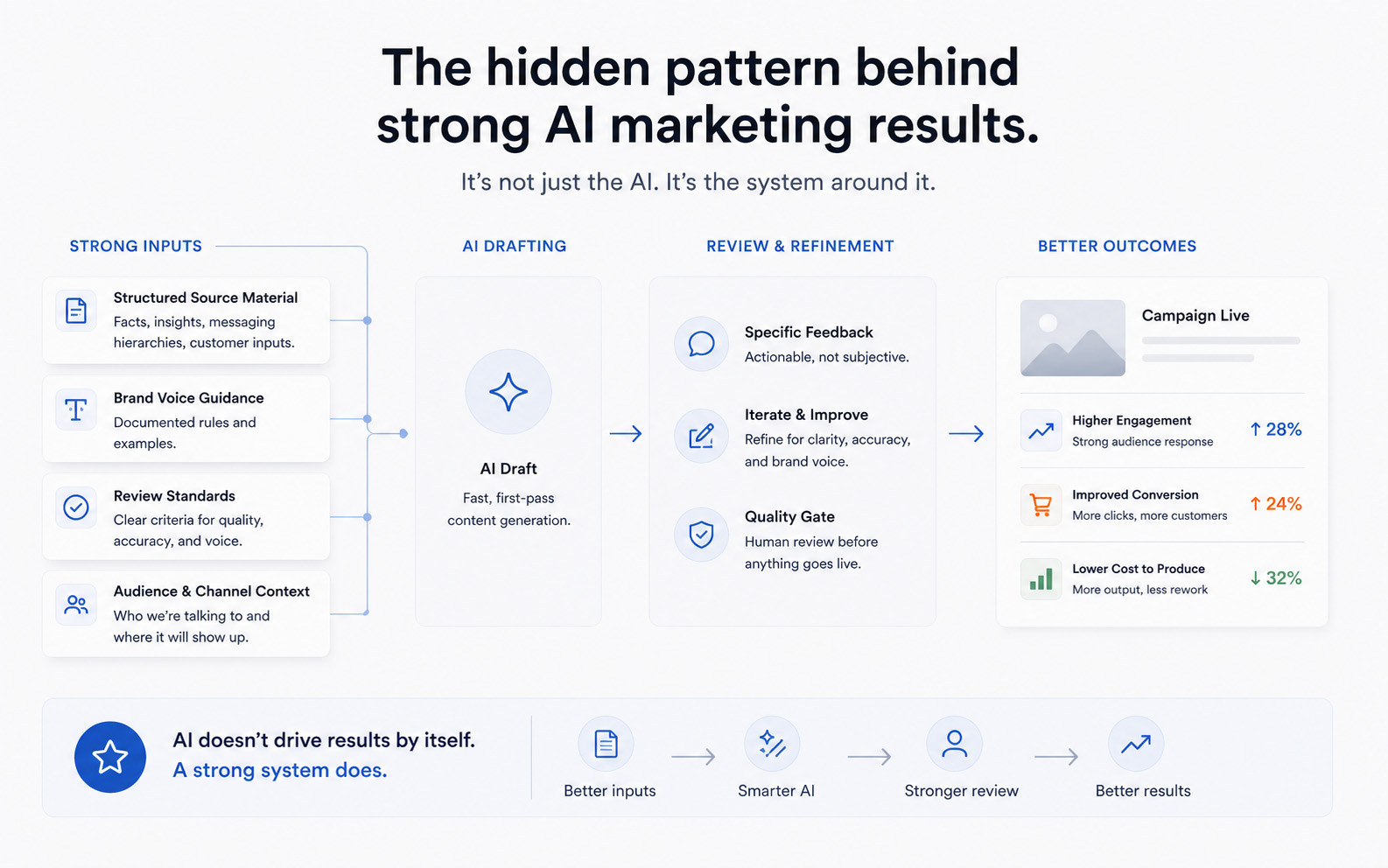
Most AI marketing case studies focus on visible output: faster content production, more personalized campaigns, higher engagement, or stronger email performance.
That is useful, but incomplete.
The stronger lesson is usually underneath the campaign. The brands getting better results with AI marketing are not just using newer tools. They are building clearer systems around how marketing work gets briefed, generated, reviewed, approved, localized, and measured.
The real pattern is not “AI made the campaign better.”
The real pattern is this:
AI marketing works better when it operates inside a governed workflow with structured source material, brand voice rules, human review, and a clear business outcome.
That is what separates a useful AI marketing workflow from a pile of AI-generated drafts.
Many AI marketing case studies show the final campaign. They highlight the creative, the performance metric, or the technology used.
What they often skip is the operating system behind the result.
That matters because most marketing teams do not fail with AI because they lack tools. They fail because the workflow around the tool is weak.
The common failure points are familiar:
In that environment, AI does not reduce work. It moves the work downstream.
Across stronger AI marketing examples, the same operating conditions tend to show up.
The AI system has access to approved facts, product data, messaging, customer language, campaign context, and examples of strong prior work.
The team defines tone, vocabulary, claims, examples, phrasing patterns, and do-not-use language. The model is not expected to infer the brand from a vague prompt.
The team knows what “good” means before drafts reach senior reviewers. Review criteria cover accuracy, specificity, brand fit, claim support, and CTA clarity.
AI supports production, variation, localization, and testing. It does not remove accountability from the people responsible for the work.
The workflow is tied to speed, cost, conversion, quality, engagement, review time, or pipeline support.
When these conditions exist, AI can improve throughput without flattening brand judgment.
When they do not, AI usually creates more drafts for humans to fix.

The following examples are not useful because they prove that AI can produce more marketing output.
They are useful because they show the workflow conditions behind stronger AI-assisted marketing.
Adore Me needed to scale ecommerce and marketplace content without weakening brand quality, style guidance, or review standards.
The company used AI agents trained on product data and style guidance to support product descriptions, stylist notes, and marketplace content. Human review stayed in the workflow, with merchandisers, stylists, and native speakers refining outputs before publication.
Operational takeaway: Adore Me’s result came from giving AI structured product data, brand rules, and human review points. The workflow did not treat AI output as finished work. It treated it as a faster first pass inside a controlled production system.
What to check before copying this:
Do you have approved product data, claims guidance, voice rules, and review ownership before AI-generated product content goes live?
Cushman & Wakefield needed to produce high volumes of localized marketing content across markets while maintaining brand and legal consistency.
The pattern here is not just “AI wrote more content.” The important point is that the workflow required governance: brand guidance, compliance awareness, and approval structure before scaled production could work.
Operational takeaway: AI-supported localization works best when the workflow defines what can change by market and what cannot change because of brand, legal, or compliance requirements.
What to check before copying this:
Do your local teams have enough flexibility to adapt content without creating brand drift or compliance risk?
As BILL increased its use of AI in content workflows, the company recognized that scale could create inconsistency, quality issues, and accuracy risk.
The stronger pattern is the response: governance frameworks, accuracy standards, and cross-functional review workflows.
Operational takeaway: AI marketing scale requires more than output volume. It requires quality standards that protect accuracy, brand consistency, and customer trust before content reaches the market.
What to check before copying this:
Can your team explain who owns factual accuracy, brand fit, legal review, and final approval for AI-assisted content?
Virgin Holidays used AI to support email subject line and language optimization while preserving brand tone.
The important workflow lesson is that performance improvement came from a feedback loop. The system generated language, performance data informed refinement, and brand voice remained a constraint rather than an afterthought.
Operational takeaway: AI email optimization works best when brand voice and performance data are connected. The goal is not only higher opens. It is higher performance without training the brand to sound generic.
What to check before copying this:
Are you measuring only the winning subject line, or are you also capturing why the language worked and how it should inform future campaigns?
Unilever has been using AI-supported content production to create product imagery and marketing assets faster and more cost-effectively. Its 2025 digital twin work shows how product data, AI, and production workflows can reduce friction in asset creation.
Unilever has also described AI as part of a broader marketing transformation, with content creation becoming faster and performance metrics improving across certain case examples.
Operational takeaway: Unilever’s AI marketing work is not just an example of faster asset generation. It shows the value of structured assets, production systems, and repeatable workflows that can support multiple brands, channels, and markets.
What to check before copying this:
Do you have modular source assets and defined usage rules, or is every new campaign still treated as a one-off production effort?
Cadbury’s Shah Rukh Khan campaign used AI-powered personalization to create hyperlocal ads that promoted local retailers during Diwali. WPP described the campaign as AI-powered and hyper-personalized, with ads featuring more than 2,000 stores.
This is often discussed as a creative AI campaign, but the stronger marketing lesson is operational: personalization at scale requires data, localization logic, approval rules, and distribution coordination.
Operational takeaway: Cadbury’s campaign worked because personalization was connected to a clear campaign structure. AI was not used to create random variations. It was used to adapt a central idea across local contexts.
What to check before copying this:
Do you have the data quality, market logic, and review structure required to personalize content without creating irrelevant or risky variations?
Farfetch used AI-supported language optimization to improve email performance while protecting its premium brand tone. Chain Store Age reported that the rollout produced average uplifts in email opens and click rates.
The key lesson is not simply that AI can write subject lines. It is that AI can support lifecycle marketing when the system is constrained by brand standards, testing discipline, and performance feedback.
Operational takeaway: Farfetch’s use case shows how AI can support lifecycle marketing when optimization is tied to brand fit and customer response data.
What to check before copying this:
Does your email workflow connect brand voice, testing results, and future prompt improvement, or are you running isolated AI experiments?
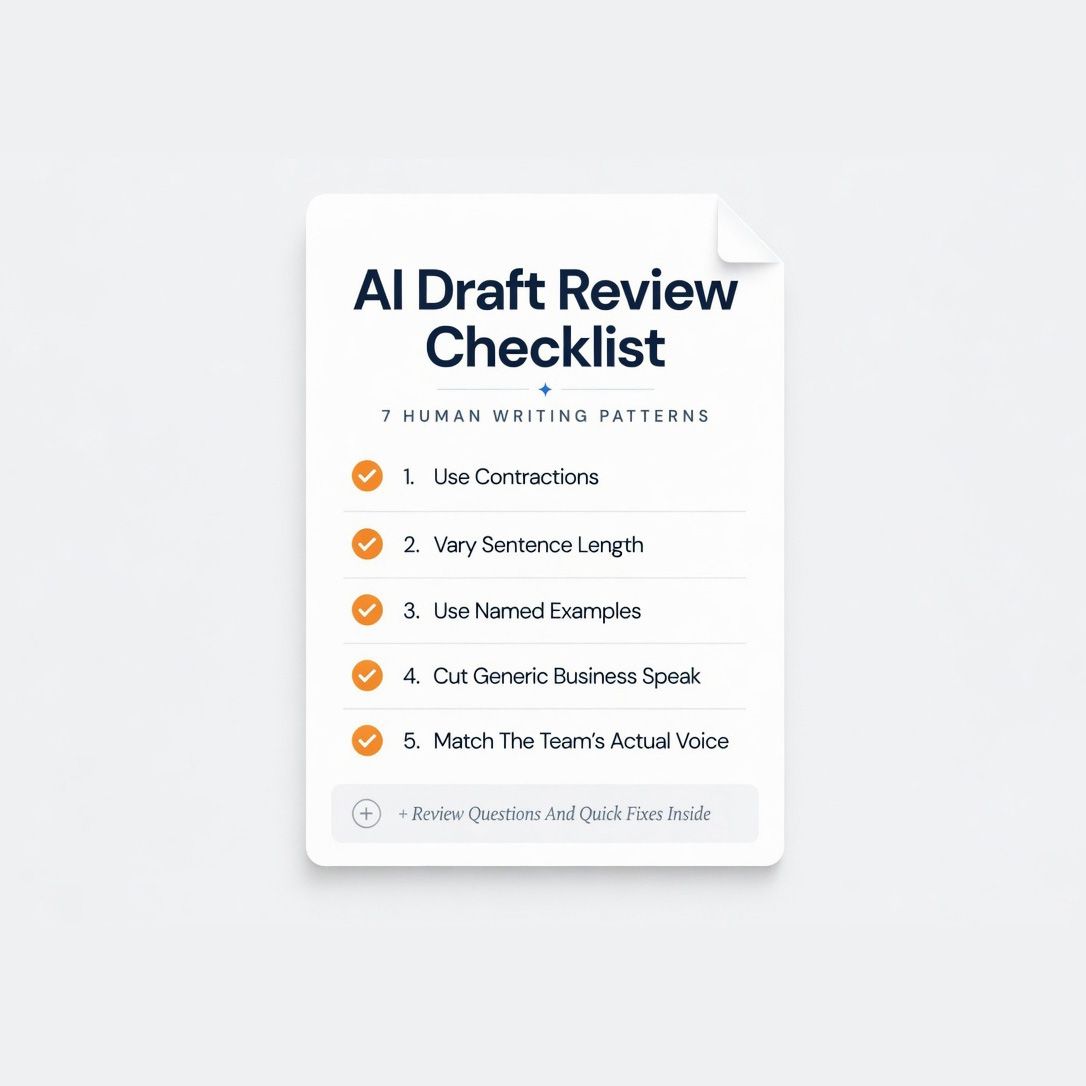
Get the 7-pattern review checklist we use to turn generic AI content into sharper, more specific, on-brand drafts before they hit an editor, client, or approver.
Get the Checklist NowNot a prompt pack. A practical review lens.

These examples point to a practical conclusion: AI marketing ROI does not usually come from isolated content generation. It comes from improving the workflow around repeatable marketing work.
The gains tend to show up in four places:
That is why the workflow matters more than the prompt. A better prompt can improve one output. A better workflow can improve every output that follows.

Teams that struggle with AI marketing usually make one or more of these mistakes:
This is how AI creates the appearance of productivity while increasing review debt. The team gets more drafts, but the same people still have to fix them.
The strongest AI marketing case studies do not prove that AI can generate more content. They show that AI performs better when it sits inside a clear operating system.
That operating system includes:
Without that structure, AI marketing becomes a volume machine. With that structure, AI can become a production-safe workflow.

Before your team scales AI-assisted marketing production, audit the workflow. Ask:
Start with one workflow. Not the whole marketing function. One source-to-output path with a clear owner, clear inputs, clear review standards, and a measurable result.
The free AI Content Review Checklist helps teams identify the quality gaps before production volume increases.
For teams that need a complete operating system, including source material mapping, brand voice capture, prompt paths, review standards, and an activation plan — the Pragmatic Content Engine provides the full framework.
The brands getting the strongest results with AI marketing are not necessarily the ones using the newest models. They are the ones building better systems around the tools they already have.
What are AI marketing case studies?
AI marketing case studies are examples of companies using artificial intelligence to support marketing work such as content production, personalization, localization, email optimization, campaign adaptation, or performance analysis. The strongest case studies show not only the campaign output, but also the workflow, governance, review process, and business result behind the work.
What do successful AI marketing case studies have in common?
Successful AI marketing case studies usually include structured source material, explicit brand voice rules, defined review gates, human oversight, and a measurable business outcome. These conditions help AI produce usable marketing work instead of generic content variations.
Why do many AI marketing efforts fail?
Many AI marketing efforts fail because teams use AI as a production shortcut without redesigning the workflow around it. Without source material, brand guidance, review standards, and ownership, AI often creates more drafts but not better marketing.
How can marketing teams use AI without losing brand voice?
Marketing teams can protect brand voice by building AI workflows around real source material, approved examples, voice rules, do-not-use language, human review, and a quality scorecard. Brand voice should be built into the workflow before production volume increases.
What should a team do before scaling AI marketing?
Before scaling AI marketing, a team should define the workflow it wants to improve, identify approved source material, document brand voice rules, assign review ownership, and create quality standards for AI-assisted drafts. Scaling before those conditions are in place usually increases review debt.
Susan Westwater is the CEO and Co-Founder of Pragmatic Digital. She helps mid-market and PE-backed teams move from scattered AI pilots to governed, measurable workflows that actually deliver operating leverage. With 25+ years in CX and brand leadership at Leo Burnett and Ricoh USA, Susan specializes in turning AI ambition into repeatable systems that protect brand voice and reduce revision cycles. She is co-author of Voice Strategy and Voice Marketing.

Get the Pragmatic Advisor, our monthly digest of real-world AI strategies for operations, strategy, and innovation.